
 Access
 Login/Register
 Supplier Login












FRITZ Haber Institute of the Max Planck Society has recently presented a potential new source of terahertz radiation for food and drug inspection applications.
The new terahertz source is the first to generate the entire bandwidth from 1 to 30 terahertz at a low cost. Compared with big and expensive equipment currently used to generate the entire spectrum that adopt very powerful lasers, the new source is less expensive to produce and is more energy-efficient and easier to operate.
Scientists at the Berlin-based institute and their partners in Mainz, Greifswald and Jülich, as well as in the US, Sweden and France, see the new source as a potentially extremely useful inspection tool for food and drugs. This is because more meaningful results can be achieved with analyses incorporating broadband terahertz radiation as it targets numerous substances.
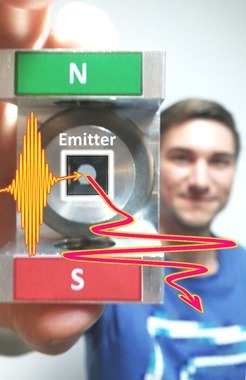
Compact and low cost: Max Planck researchers have developed a new source of radiation across the entire terahertz spectrum that is expected to enable new applications for this radiation. (Photo © Fritz Haber Institute of the Max Planck Society)
The new source’s emitter, which resembles a solar cell, is powered by a compact femtosecond laser that generates 80 million ultrashort flashes of light per second. The emitter’s metallic bilayer, one of its two metal layers with the other one being nonmagnetic but both 3 nanometers thick and grown on a glass substrate, converts into a type of antenna that emits electromagnetic waves with terahertz frequencies when hit by an ultrashort laser pulse.
The emitter’s efficiency lies in the charge of the flowing electrons and their spin, said Tom Seifert, a doctoral student at the Fritz Haber Institute. The electron’s spin can have two distinct values and makes the current behave differently in magnetic than in nonmagnetic metals.
The laser light excites different numbers of electrons, with the magnetic layer having two possible spin directions. Depending on their spin, the electrons are deflected into opposite directions on the nonmagnetic layer, which then creates a current that is perpendicular to the electrons’ original movement direction. This current burst generates the terahertz pulse. The thinness of the metallic bilayer ensures the electromagnetic radiation is not significantly weakened on its way out of the metal as would otherwise be on a thicker layer.
Terahertz waves, which lie between 0.3 and 30 terahertz in the electromagnetic spectrum between microwaves and infrared light, are useful for analysing organic materials. Unlike X-rays or other sources of radiation, terahertz radiation is completely harmless. It can be absorbed by many pharmaceuticals and can penetrate things such as textile and plastic.
According to Tobias Kampfrath, leader of the Terahertz Physics Research Group at the Fritz Haber Institute that spearheaded the development process, "Our method of generating terahertz radiation makes applications possible that were previously too costly for such sources."
"We anticipate that it will quickly find use on a broad basis," said Mr Seifert.
Journal Reference:
T. Seifert, S. Jaiswal, U. Martens, J. Hannegan, L. Braun, P. Maldonado, F. Freimuth, A. Kronenberg, J. Henrizi, I. Radu, E. Beaurepaire, Y. Mokrousov, P. M. Oppeneer, M. Jourdan, G. Jakob, D. Turchinovich, L. M. Hayden, M. Wolf, M. Münzenberg, M. Kläui, T. Kampfrath. Efficient metallic spintronic emitters of ultrabroadband terahertz radiation. Nature Photonics, 2016; DOI: 10.1038/NPHOTON.2016.91
Max-Planck-Gesellschaft. "Terahertz radiation: Useful source for food safety: Compact, low-cost emitter generates light across the entire terahertz spectrum." ScienceDaily. www.sciencedaily.com/releases/2016/06/160617104928.htm (accessed August 12, 2016).
Nike