
 Access
 Login/Register
 Supplier Login












IN SOME areas of Viet Nam, indigenous farmers have been cultivating coffee with great skill and tradition for almost 200 years. Among them are the K’ho people of the Lam Dong region in the central highlands, who have been growing high-quality Arabica coffee since the French introduced it to the region. In an exclusive interview, Josh Guikema, co-founder of the K’ho Coffee Grower Cooperative, talks about the business and how the K’ho people took greater control over the region’s unique cultural, environmental and economic future by developing their own brand for their own coffee beans.
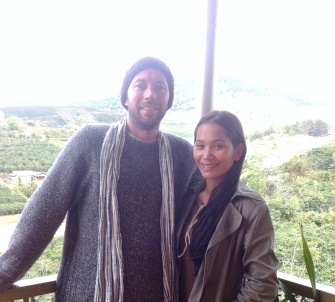
Joshua Guikema is married to Rolan CoLieng who is a member of the K’ho Cil mountain tribe community based near Lang Biang Mountain. They are co-founders of the K’ho Coffee Grower Cooperative
How would you describe the K’ho Coffee Grower Cooperative as a business structure?
The Cooperative brings together a large number of key stakeholders from the Lam Dong region to form a business that has complete control over the coffee production supply chain, from seed in the ground to the consumer. K’ho Coffee has a number of business objectives associated with the company’s vision: preservation of the land, sustainable framing practices, quality assurance of production and product, preservation of the K’ho Cil culture and their traditional way of life, and always being a fair trader in our business dealings, particularly with growers; and a good price for a good product.
K’ho Coffee is made up of dozens of K’ho Cil families from the central highlands region that have been growing great coffee for a long, long time, so the Co-Op’s co-founder Rolan CoLieng and myself, just made some additions to the existing supply chain – areas such as product and process development, marketing and branding, quality assurance, sales and distribution. We’re a young company, with our first harvest only being in 2012, but we’re always working towards continuous improvement, so we’ve come a long way in a short time.
It’s also good to remember that K’ho Coffee operates in the niche market of organically grown coffee, so we’re not competing against the big players and dealing in large quantities, so we’ve had the luxury of not having to enter the market too aggressively. You could also describe K’ho Coffee as a social enterprise built on socially orientated business values; an organization owned by the community with the express purpose of benefitting the community.
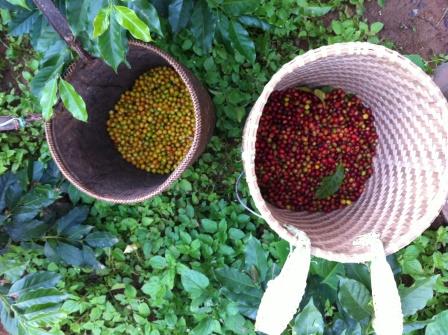
Fresh from the field, Arabica coffee cherries from K’ho family farms
Why is it ideal to grow coffee in the Da Lat highlands?
The French came and started to develop the region in the late 1800s, and proceeded to build the French cool climate outpost that would eventually become the highland City of Da Lat. It became evident to the French that the cool temperate year round climate was ideal for a large number of agricultural crops like fruit trees, vegetables, grapes, flowers and coffee. The climate was ideal for the Arabica strain that thrived in the region’s volcanic soil. The K’ho farmers are still using descendants of those original French plants. We grow organically with hand harvesting and sorting, constant grading through every step of the process, and work to the highest of quality standards.
We have a passion for coffee here. From an operational perspective, we look very seriously at environmental sustainability. Keeping life in balance is a strong motivator. This year we’ll roast around 3 tons of clean organically grown highland coffee. As we operate in a relatively small niche organic market we’re more than happy with the level of production we’re experiencing at the moment, and preparing for an increase in capacity as demand increases.
Please tell us about the range of K’ho Coffee products.
We offer a number of different products which are brought about through the different roasting processes we use and produce the different flavors. The washed process produces a bean excellent for espresso coffee, or our honey process for a sweeter, less bitter taste. We’re also starting to move into the growing and processing of green teas. Up in the highlands where we grow, it’s all mountain farming, rough terrain, so driving motor bikes up into the mountain and coming back with 200 kilos on the back is certainly hard work.
The K’ho Cil people are very different from your average Vietnamese, with their own culture, language, arts and crafts, and as I mentioned before, we still do a lot of the processing the traditional way, by hand, which maintains the quality and adds to the unique taste of our coffee beans. Our processes are still what you would describe as somewhat old fashioned and low tech, but we feel this only adds to the uniqueness of our coffee. Our product range consists of: Village Arabica, a single origin blend selected from the best of the harvest; Café Vang (Golden Coffee) is a rare coffee in Viet Nam consisting of bright yellow cherry Arabica varieties, Amarillo Caturra and Yellow Bourbon; Indochina Heirloom is an old world coffee variety, originally grown from seeds and preserved by the mountain tribes; Original Single Origin Espresso, made from only the best washed aromatic Arabica coffee beans; Highland Honey Arabica, honey processed (semi-washed) coffee beans; and Peaberry high density hand sorted coffee beans.
You mentioned that production is largely traditional.
As the cherries ripen at different times it’s always best to pick by hand – they haven’t made a machine that can do this job better than a human. We then do a lot of hand sorting to get the best quality. After hand sorting there are a number of different process options we follow. If we’re doing a washed process we’ll pulp the beans, take off the cherries and then place the beans into the fermentation tank for 24 hours. The beans are then washed clean of all of the fermented sugary mucilage and then prepared for drying.
If we’re doing the honey process, we’ll coat the beans with honey and let them dry to produce a glazed effect. The beans then proceed to the dry mill to remove parchment skin. Then after more hand sorting and grading by size, it’s off to the roaster for about 20 minutes for the critical last step. We then deal with inventory management and the logistics of supplying market demand.
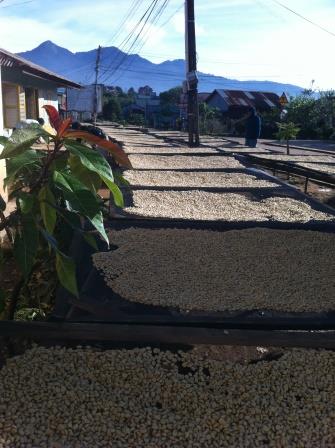
Parchment coffee drying for 10 days after cherry pulp is removed
Local demand must be huge, but is the Cooperative also export-oriented?
There is potential for the export market, but it’s more for green beans, so we prefer to cater to the domestic roasted market, which is quite big in Viet Nam. They drink a lot of coffee here, and being the second largest producer of coffee in the world, Viet Nam also has a lot of coffee, so it can be a very competitive market. Fortunately, we’re growing Arabica beans where most of the growers here grow Robusta, which gives us a competitive edge. We’re also reasonably priced in comparison to other organic coffee products on the market, and that helps. But it’s really our intention to build the brand on providing consistent high quality products and service. We’re slowly building our online presence through our website and social media and we’ll continue to build on that to support our marketing and sales efforts. We’ve also started to implement our direct marketing strategy with having a presence at Farmers Markets and exhibitions. Additionally, we don’t want people to buy our product only for what we do or how we do it, but for why we do it. At K’ho Coffee it’s important for us to find the balance between the cultural, environmental and economic needs of the community.
Is the company planning on making a great push forward in 2015, particularly with the AEC integration coming online soon?
We’ll continue to create a strong foundation for the Cooperative as we move forward, and continue to develop other markets and product lines such as tea and possibly cocoa. The AEC Integration is very exciting for us as we see the opportunity of expanding our markets within the region. Presently, countries like Thailand have an import duty on coffee products, even though they don’t produce enough beans to cover their own domestic consumption, so we see great potential for market expansion with the development of the ASEAN Economic Community. Regarding our plans for 2015, well, I guess proceeding with cautious optimism would best describe our corporate strategy for the coming year.
Nike