
 Access
 Login/Register
 Supplier Login












As part of its company-wide quality protocol, FMC Technologies in Dunfermline, Scotland invests continually in a preventive maintenance programme that employs Renishaw machine tool probes and calibration products to check and verify the dimensional accuracy of its CNC machine tools. The resulting data are stored for quick and easy retrieval using Renishaw's CNC Reporter software.
FMC Technologies is a Houston, Texas-based developer and manufacturer of oil and gas Production Control Systems (PCSs).
A PCS consists of topside (surface) controls, power equipment, the Subsea Control Module (SCM), various sensors, and subsea electrical and hydraulic distribution equipment. The whole system is configurable according to conditions and requirements, and provides engineers on-board an oil or gas production platform with precise control of the well.
FMC Technologies has operations around the world, close to the major oil and gas industry epicenters. Its UK manufacturing operation occupies several buildings on and around the Pitreavie Business Park, Dunfermline, a short drive from Edinburgh, across the Forth Road Bridge.
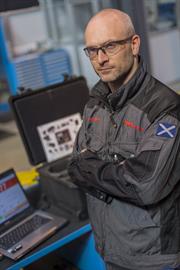
Craig Simpson and Mike West are FMC Technologies maintenance technicians, with responsibility for the service and support of 20 CNC machine tools of various types, makes and ages. Also in their charge is one of the company's more recent investments: a £2.5 million, purpose-designed and built, SCM machining cell, consisting of two Okuma Space Centre MA-600HB CNC horizontal boring machines, loaded and managed by a Fastems automation system.
An SCM contains electronics, instrumentation, and hydraulics for safe and efficient operation of valves and chokes on the well-top ‘subsea tree'.
“There are four, main, machined parts in an SCM,” says Craig Simpson, “one high, and one low pressure adaptor plate; the manifold block itself, and a base plate. There are also a large number of small valves and electronic circuit boards that go into the whole assembly.”
Wells can be as far as 120 km from the production platform, in water up to 10,000 feet deep. Producing oil and gas safely and reliably under such conditions requires companies to make enormous investments. When an SCM is installed on the seabed, it has to be reliable and safe for the production life of the well, which can be decades. Hydraulically controlled valves must be free from defects and contamination. If a critical part malfunctions, the potential cost can easily run to tens-, or even hundreds-of-millions of dollars.
The Fastems automated cell is used to machine the stainless steel hydraulic manifold block, which is a critical control element in an SCM assembly. The 267 kg block is approximately 400 mm x 400 mm x 400 mm and is a complex of 350-drilled holes. The company will make more than 200 manifold blocks in 2014, when the cell is fully operational and capable of working ‘lights-out'. Should a tool break during the machining cycle, a Renishaw NC4 laser-based tool setting system will detect the tool absence and notify the Fastems system, which will reject the pallet and replace it with another.
Guiding principles
FMC Technologies is guided by what it calls the 5-absolutes of quality, the second of which emphasizes the importance of prevention, ‘not appraisal' as the ‘cause' of quality.
“Quality control in the new cell is extremely thorough,” adds Mr. Simpson. “The finished part is 100% inspected and has to be precise and flawless before it can be shipped to assembly.”
For example, since each SCM manifold block takes up to 35-hours to machine, FMC Technologies engineers need to kNIKE AIR FORCE