
 Access
 Login/Register
 Supplier Login












TOKYO – Tanaka Kikinzoku Kogyo K.K., which operates the Tanaka Precious Metals Group's manufacturing business, had become the world's first company to succeed in the development and formation of platinum-based metallic glass powder supporting selective laser sintering 3D printers. The company also succeeded in developing platinum group metallic powder using nickel-based alloys with platinum and iridium additives, and manufacturing objects using them.
Tanaka Kikinzoku Kogyo will have an exhibit at POWTEX TOKYO 2014 at Tokyo Big Sight from November 26 to 28 and after showcasing these platinum group powder materials for the first time, sample delivery will start in December.
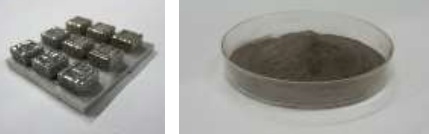
Platinum-based metallic glass blocks (each block is 8x8x5mm) and the platinum-based metallic glass
powder material
The company obtained a patent for the composition of platinum-based metallic glass in 2004, and with this development, it became the first in the world to powderize platinum-based metallic glass that can be used in existing selective laser sintering 3D printers by adjusting particle diameter and fluidity through the use of proprietary equipment. Two types of powder material using nickel-based alloys with platinum and iridium additives were also developed
This marks the world's first formation of platinum-based metallic glass using 3D printers. Tanaka Kikinzoku Kogyo will provide platinum group metallic powder, in addition to processing the diameter size of platinum group metallic powder particles, proposing formation in the manufacture of platinum group alloys, and manufacturing objects depending on requests from customers.
Platinum group metals have a high melting point and are durable, but many – especially alloys – have poor workability such as cutting and plastic forming, and there were limitations in the shapes available using existing forming methods. Enabling these materials to be formed using 3D printers makes it possible to form complex shapes and manufacture complex products using materials with different melting points.
This development is expected to lead to small lot production of a diverse range of products requiring corrosion resistance such as medical materials, and the expansion into industrial products with specialized components in areas requiring heat resistance such as the automotive industry and the aerospace industry.
Air Force 1 High