
 Access
 Login/Register
 Supplier Login












The quantity of electronics found in all areas of modern road vehicles continues to rise. and electric drive systems are now entering the mainstream. So the need to ensure the reliable performance of electrical and electronic components and systems is taking on new importance. Polymer-based solutions from Henkel provide high levels of protection for different types of these components.
Countless safety systems in various types of vehicles depend on the continuous high-level functionality of interconnected electronic components, often positioned in areas that are exposed to wide temperature variations, to oils and greases, to moisture, dust, stone impacts, and vibrations. For these reasons, it is important that, wherever possible, electronic and electrical components are securely protected from the environment.
Options to protect
Several solutions are now available to ensure protection and performance of electronic and electrical components. Henkel has introduced three options: Technomelt low-pressure moldable hot-melt polyamides for encapsulation of plugs, sockets, sensors; Loctite acrylic impregnation resins for sealing microscopic gaps in metal/plastics hybrid components; and Thermally conductive potting resins for electric propulsion components.
In the low-pressure hot-melt molding technique, resin is injected around components fixed in a closed mold. The hot-melt serves as an encapsulant and also as a housing, so there is no need for a separate shell to protect the components. Once the hot-melt material has cooled and solidified, the components are ready for further processing. Resins for hot-melt molding are single-component polyamide systems that can be used in simple and clean production processes. These processes take up little floor space; they are fast and energy-efficient.
Henkel Technomelt hot-melt molding materials provide high humidity resistance, temperature resistance up to 150°C, and impact resistance down to -50°C. This makes them superior to many other polyamide hot-melts, which normally can be used in environments of up to only 120°C and are more prone to hydrolysis.
The new materials from Henkel are the result of experience in hot-melt molding for the automotive industry that dates back over 25 years. They provide new opportunities for higher temperature applications in humid environments, such as sensors in door handles, rear view cameras, batteries or tire pressure monitoring systems, or for sealing aluminum cables.
Acrylic impregnation products such as Loctite IS 5100 provide a sealing solution for electrical and electronic components. Microscopic voids are inherent in many electronic assemblies that combine metal and plastics elements. Over time in the field, these voids can cause product failures, so it is important that they are filled before the parts are put into vehicles. Henkel offers an impregnation service, either on-site or at its own service centers, for permanently sealing parts such as sensors, connectors, coils and electronic housings. Once impregnated, these components are protected from moisture, solvents, fluxes and other corrosive agents.
The impregnation process involves putting parts into a vacuum chamber, which is then filled with the acrylic resin. Once this has filled all the gaps in the parts, excess resin is removed by a centrifuge and parts are then thoroughly washed and rinsed before the remaining resin is allowed to cure. All parts go through a leak test to guarantee that the process has sealed the parts.
Impregnation is a fast, high quality, cost-effective sealing solution that can be used on existing parts without any need for design changes. Once treated, parts have the same dimensions and surface aspect as untreated parts, but their durability and long-term reliability is considerably improved. The specially developed acrylic resin protects against moisture, chemicals and dust, and remains flexible, retaining its sealing properties, throughout multiple thermal cycles. The process is unique to Henkel. Since it is offered as a service, customers do not need to invest in any capital equipment.
Henkel’s thermally conductive potting materials are intended for electric automobile propulsion components that require support in dissipating generated heat.
Today’s compact high-performance electric propulsion components have a high power density. This inevitably leads to the generation of heat, which must be discharged to the cooling system on the outside if reliability is not to suffer. Henkel offers a variety of thermally conductive and electrically insulating potting materials that meet the technical and processing requirements of this application.
Heat and hot air resistance
The BMW Group's B58 3-litre straight-six petrol engines features an integrated indirect charge air cooler from MAHLE. The system is made from DuPont™ Zytel® PLUS nylon which has particularly good resistance to heat and hot air ageing. The aluminum heat exchanger, through which coolant flows, is inserted lengthwise into the housing on guides which have sealing strips made from the same polymer. The innovative structural design of this charge air cooler means it can be arranged in the immediate vicinity of the engine, so minimizing bulk and pressure drop and helping to optimize the balance of performance and fuel efficiency. The BMW Group has been using the B58 engine in its 740i, 440i and 340i models since late 2015.
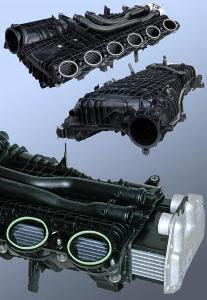
An intake system made from DuPont's Zytel® PLUS nylon, with its good ageing and temperature resistance.
This innovative application has been jointly developed by a team from Mahle, BMW and DuPont Performance Materials who selected the glass fiber reinforced grade Zytel® PLUS 95G35. This choice arouse from the product’s inherent outstanding resistance to chemicals and temperatures of up to 230 °C combined with a very good weldability. For this application, high weldability, using friction welding, is particularly important given the large size of the upper and lower parts of the housing which are molded in one shot in an injection molding tool with an 1+1 cavity.
Zytel® PLUS is produced using DuPont's proprietary SHIELD technology which combines an innovative polymer backbone architecture with specific polymer modifications and additives. Zytel® PLUS 95G35 is the multipurpose product within this product family. Thanks to its very high heat resistance, it retains the majority of its mechanical properties even after 3000 hours at 230 °C, bearing in mind that the properties of conventional PA66-GF35 grades drop to below half their initial value at 180 °C.
"The result of our joint collaboration with the BMW Group and MAHLE is a current example of how OEMs and tier-1 suppliers can benefit from our comprehensive product range and development abilities.