
 Access
 Login/Register
 Supplier Login












USING a new portable device, consumers can instantly spot-check if what they are about to purchase is authentic or mislabeled seafood. The new instrument developed by scientists at the University of South Florida's College of Marine Science will help in the fight to expose fraudulent seafood species claims, straight from the docks or in a restaurant.
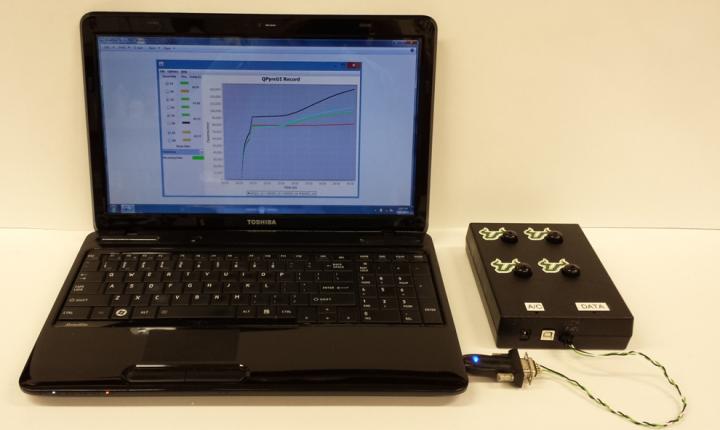
The QuadPyre RT-NASBA offers a fast and inexpensive method to evaluate the authenticity of seafood. It assays seafood samples using real-time nucleic acid sequence-based amplification (Photo courtesy of the University of South Florida)
Further described in a paper appearing online in Food Control, the sensor called QuadPyre RT-NASBA can detect grouper.
"Is it grouper?" To this question the QuadPyre RT-NASBA will give a thumbs-up or thumbs-down in a fast, cost-effective way on-site aboard ship, dockside, in warehouses or in restaurants. The instrument assays seafood samples using real-time nucleic acid sequence-based amplification (RT-NASBA). It purifies and identifies the sample's RNA similar to a previously developed lab-based benchtop model.
"Using the handheld device, a complete field assay, potentially carried out at the point of purchase, requires fewer than 45 minutes for completion and can be performed entirely outside of the lab," said paper co-author and biological oceanographer John Paul, Distinguished University Professor at the USF College of Marine Science. "Some past assay procedures could take hours, even days to identify samples."
Grouper is vulnerable to fraud since it is the third most economically valuable seafood product in Florida and there are commercial quotas on grouper catches, explained Robert Ulrich, lead author and College of Marine Science. The task of identifying true grouper is complicated because the U.S. Food and Drug Administration allows 64 species of fish to be labeled as "grouper."
"The demand for grouper in the U.S. is so strong that it cannot be met by the harvesting of domestic species alone," said Mr Ulrich. "In 2012, over 4,000 metric tons of foreign grouper, worth $33.5 million, were imported into the US. This mass quantity of imported grouper creates opportunities for fraud, which can lead consumers to pay more for lesser valued seafood species and may allow importers to avoid paying tariffs."
Just as it can distinguish well between raw fish species, the sensor can also detect grouper substitution even when fish is cooked, or masked with breading or sauces. This capability is an improvement over other techniques which fail to make the difference on cooked seafood.
The technology is being commercialised by a USF spinoff company called PureMolecular, LLC under the name GrouperChek (trademark pending). Assays for other commercially important seafood species are being developed. Assays already exist for non- seafood problematic species such as Karenia brevis (red tide-causing organism), noroviruses and enteroviruses.
"Federal and State governments are behind the need to protect US seafood consumers," said Mr Paul. "A bill on seafood safety was recently introduced in the U.S. Congress and work on similar bills is in process in Maryland and Massachusetts. In addition, a multi-agency Presidential Task Force was established in 2014 and has made recommendations to the White House regarding the development of forensics technology for seafood identification."
It is estimated that up to 30% of the seafood entering the US is fraudulently mislabeled, and cost U.S. fishermen, the U.S. seafood industry, and American consumers some $20-25 billion annually.
Zapatillas Running Baratas