
 Access
 Login/Register
 Supplier Login












IT IS important to realize that the psychological effects of food coloring are not restricted to the sensory-discriminative domain. It has often been suggested that food coloring can modulate certain of our food-related behaviors as well [91],[92]. Certainly, getting the color right can play an important role in food acceptance, liking, and hence, ultimately, food intake [24],[93]-[97]. Though, as pointed out by Garber et al. [85], while it is often claimed that color influences food preferences, good, marketing-relevant insights tend to be a little harder to come by in this area.
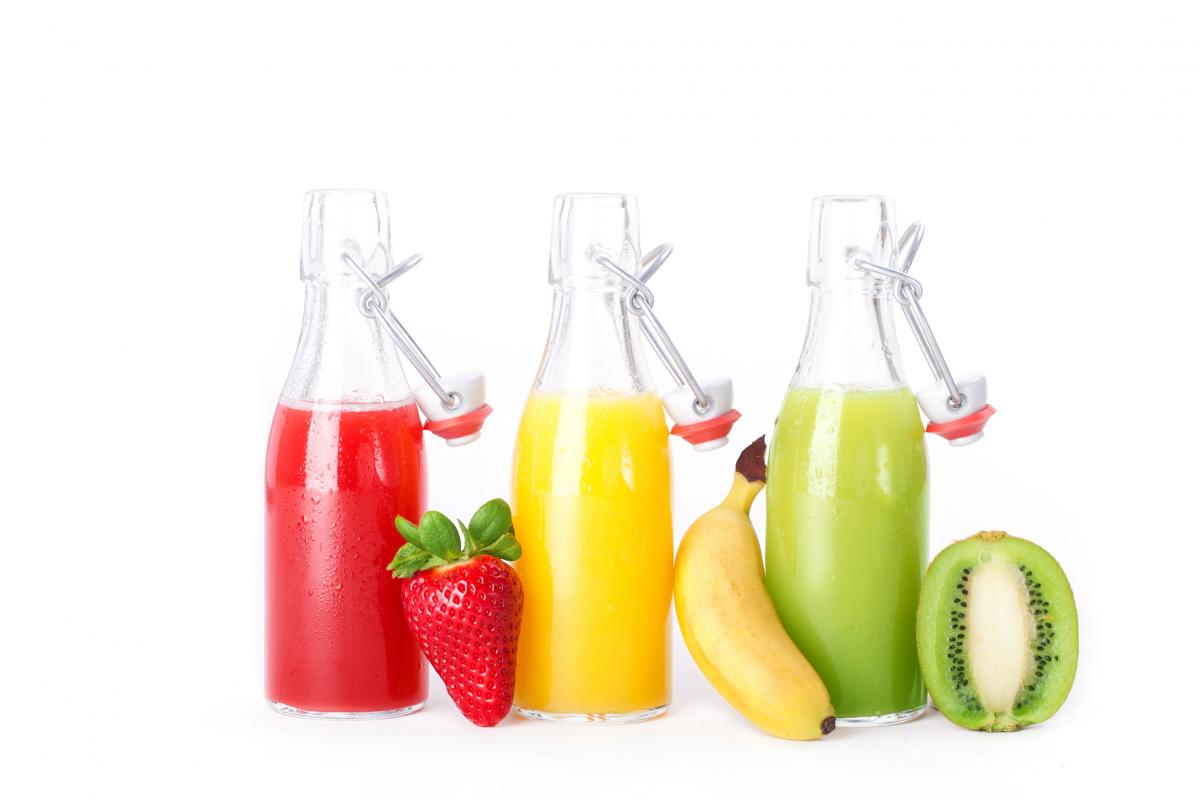
Consumers expect food to come in their natural colors (Fruit juice © Peppi18 | Dreamstime.com)
Color can play an important role in modulating a consumer’s affective expectations [32],[98]. And just as there can be a sensory disconfirmation of expectation (as outlined above), there can also be a hedonic disconfirmation of expectation – that is, when a consumer realizes that they do not like a food or beverage as much as they were expecting that they would.
In other research, it has been shown that people will consume more candy if it comes in a variety of colors than if presented in just a single color [99], even if that color happens to be the consumer’s favorite one. Whether sensory-specific satiety or boredom is the most appropriate explanation for such results is still being deliberated by researchers (see [92], for a review). Interestingly, while the use of color (specifically increasing color variety) is usually portrayed as a means by which the big food companies can get their consumers to consume more (think only of the multicolored packs of Smarties, M&Ms, or Jelly Beans), there is some evidence to suggest that color cues can also be used to modulate intake downward, by providing an effective cue to portion control ([100] see also [101],[102]). So, for example, Geier et al. [100] reported that people ended up eating fewer potato chips if every seventh chip in a tube happened to be colored red.
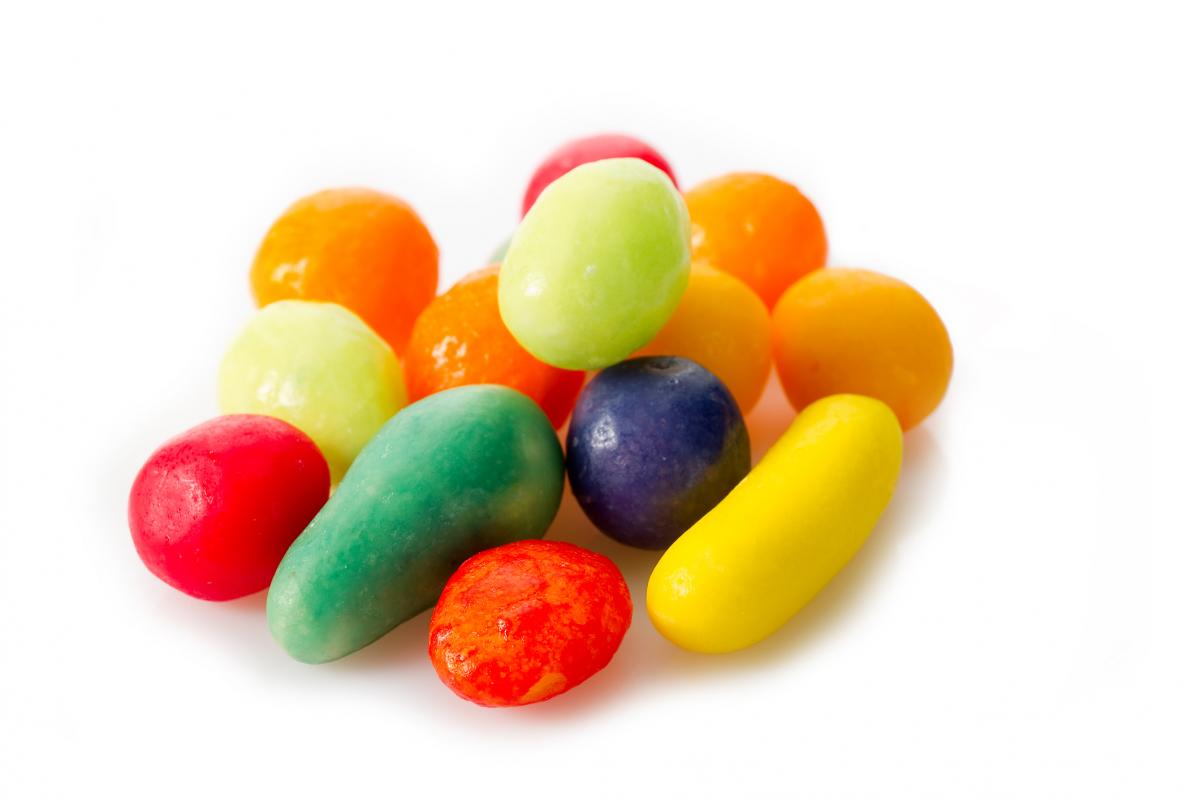
Research shows that consumers will eat more candy if it comes in a variety of colors as compared to only one (Mixed candy © Marcomayer | Dreamstime.com)
Off-coloring in food
Researchers have been interested in the response of consumers to food coloring that they associate with products that have been in some way spoiled. That such off-colors can have a profound effect on people’s food behaviors was suggested by the response of consumers to a batch of Tropicana grapefruit juice that was donated to a food bank some decades ago. According to Crumpacker ([14], p. 6), nobody wanted to drink the juice because of its abnormal brown color. This despite the fact that those who tried it reported it to taste perfectly acceptable; see also [59],[81],[103], on the preferred color of this staple of the breakfast table.
Meanwhile, the dinner party guests in Wheatley’s [15] classic study were invited to dine on a meal of steak, chips, and peas. The only thing that may have struck any of the diners as odd was how dim the lighting was. However, this aspect of the atmosphere was actually designed to help hide the food’s true color. Part-way through the meal, the lighting was returned to normal, revealing that the steak had been artificially colored blue, the chips looked green, and the peas had been colored red. A number of Wheatley’s guests suddenly felt ill when the lighting was turned to normal levels, with several of them apparently heading straight for the bathroom (cf. [54]).e
It is noticeable how the majority of the research on the psychological impact of off-color in food is rather anecdotal in nature (presumably because it can be difficult to get ethical approval to present food to participants and have them believe that the color indicates that it has gone off). Nevertheless, the evidence that has been published to date does seem to highlight the strong avoidance responses that such food coloring can induce, especially in the case of meats and fish that look off.f
Artificial/natural
Over the years, there has been ongoing concerns expressed about the negative health and well-being consequences that are apparently associated with the consumption of certain artificial food colorings, this despite their being rated as being safe and tasteless [24],[104]-[116]. This had led some consumers to search out those foods that are free from all coloring. However, such products generally do not taste that good. As Harris pointed out in an article that appeared in The New York Times[24], many commercial foods are disappointingly lacking in taste/flavor if served in a colorless (that is, clear or white) format.
A less extreme reaction to concerns over artificial food colorings has been to search out natural colorings that better match the sensory properties desired by the food producers: This includes everything from trying to deliver a wide enough range of natural colors [117], through to improving the stability of natural colorings, at least for those products that are likely to have a long shelf life [118]-[120]. Of course, that food coloring is natural does not in-and-of-itself necessarily make it appealing to the consumer. Here, one only needs to think of the red coloring of, for example, Smarties (the candy-covered chocolate; (http://www.nestle.co.uk/brands/chocolate_and_confectionery/chocolate/smarties) that used to be made from carminic acid extracted from scaly insects. Unappealing to most consumers, one imagines. Nowadays, though, the red coloring comes from red cabbage instead [116].
And what, exactly, constitutes natural is not obvious. The vibrant orange-colored carrots that we are all familiar with nowadays, for example, are actually the result of extensive breeding. Once upon a time, the majority of carrots were naturally purple. According to some, the selective breeding was designed to deliver the orange color of the Dutch royal family in the seventeenth century [121]-[123]. Although another, perhaps more plausible, explanation for why the orange variety may have been preferred over the original purple variety was because the latter would color the soups, stews, and so on into which they were placed.
A number of the modernist chefs we have been fortunate enough to work with here at the Crossmodal Research Laboratory at Oxford University over the years have been particularly interested in surprising their diners by presenting foods that have one color (and hence set a particular taste/flavor expectation) while actually delivering another unexpected flavor instead.g However, the chefs typically do not want to achieve such results by means of artificial food colorings for fear of their diners’ reaction.
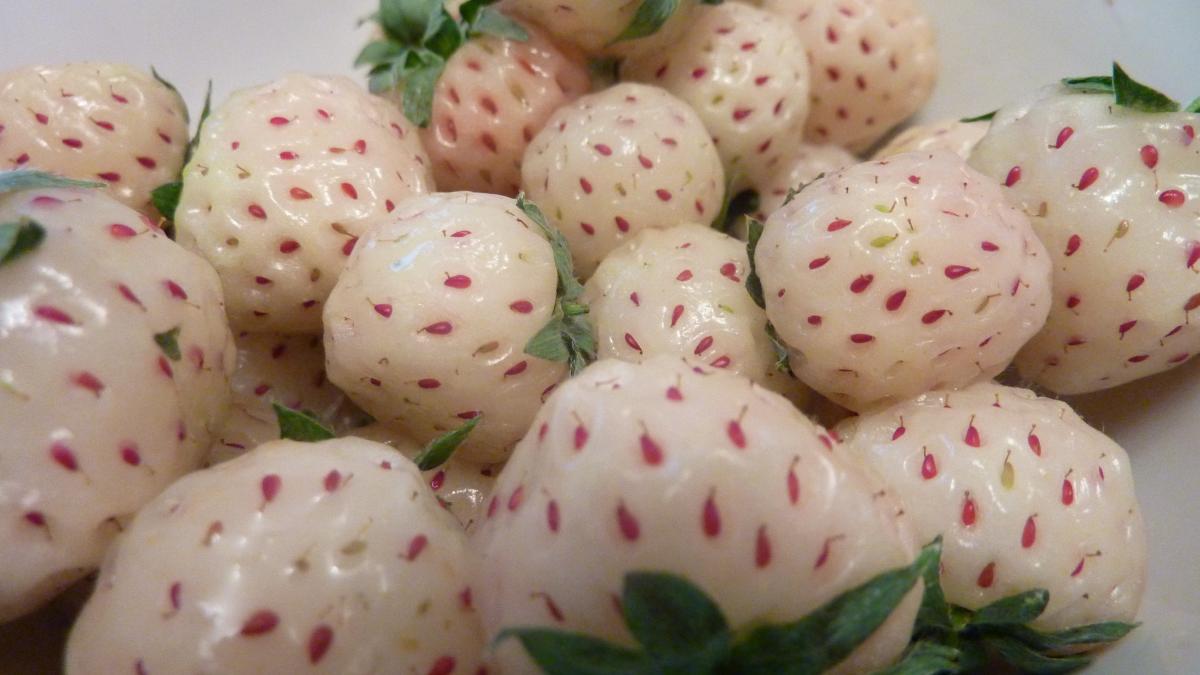
Pine berries look like unusual strawberries (Photo: Emmbean/Wikipedia)
One elegant example of the use of natural coloring to create surprise and delight in the mind of the diner comes from the beetroot and orange jelly dish that used to be served as one of the opening courses on the menu at The Fat Duck restaurant in Bray (http://www.thefatduck.co.uk/). This dish would be presented as two blocks of jelly, one bright orange, the other a dark purple, placed side-by-side on the plate. And where the modernist chefs lead, the market sometimes follows. Pine berries, for example, which look for all-the-world like white strawberries provide an intriguing example of an otherworldly, at least to Western eyes, but entirely naturally colored food.h Such unusually colored food products have apparently been selling well in the supermarkets in recent years (see also [123]). More generally, there would appear to be renewed interest in surprisingly colored foods in the mass market as well. For example, a few years ago, one well-known burger chain launched a pitch black bamboo and squid ink burger in Japan, that was seasoned with black squid ink ketchup, and served in a black bun [124]. As a group, children seem to be particularly fond of such miscolored foods (think confused Skittles; http://www.wrigley.com/uk/brands/skittles.aspx) and beverages [125]-[128].
*This is an excerpt from the article “On the psychological impact of food color” by Charles Spence published on 22 April 215 in Flavour journal.
Notes
eNo mention is made of whether ethical approval was obtained for this particular study!
fThough note that olfactory cues are at least as important in people’s judgment of whether a food has gone off ([169]; see also [170] on the consumer evaluation of the sensory properties of fish).
gNote that while under the majority of everyday conditions, people prefer foods and beverages that taste as they expect them to taste (that is, people do not like surprises, especially when it comes to the stimuli that enter the mouth, and hence have the potential to poison them), there are occasions, such as at the tables of the modernist restaurant where many diners seem to positively relish having their expectations played with [1],[125].
hThese ‘white strawberries’ are the result of cross-breeding the South American strawberry Fragaria chiloensis, which grows wild in some parts of Chile, and the North American strawberry Fragaria virginiana.
References
1 Spence C, Piqueras-Fiszman B. The perfect meal: the multisensory science of food and dining. Wiley-Blackwell, Oxford; 2014. 
15 Wheatley J: Putting colour into marketing. Marketing 1973, October:24–29, 67.
24 Harris G: Colorless food? We blanch. The New York Times 2011, April 3:3. Downloaded from http://www.nytimes.com/2011/04/03/weekinreview/03harris.html?_r=0 on 21/12/2014.
32 Zellner D, Strickhouser D, Tornow C. Disconfirmed hedonic expectations produce perceptual contrast, not assimilation. Am J Psychol. 2004; 117:363-87. PubMed Abstract | Publisher Full Text
54 Moir HC. Some observations on the appreciation of flavour in foodstuffs. J Soc Chemical Ind: Chem Ind Rev. 1936; 14:145-8.
59 Fernández-Vázquez R, Hewson L, Fisk I, Vila D, Mira F, Vicario IM et al.. Colour influences sensory perception and liking of orange juice. Flavour. 2014; 3:1.
81 Hoegg J, Alba JW. Taste perception: more than meets the tongue. J Consumer Res. 2007; 33:490-8. 85 Garber LL, Hyatt EM, Starr RG. Placing food color experimentation into a valid consumer context. J Food Products Market. 2001; 7(3):3-24.
91 Birren F. Color and human appetite. Food Technol. 1963; 17(May):45-7.
92 Piqueras-Fiszman B, Spence C. Colour, pleasantness, and consumption behavior within a meal. Appetite. 2014; 75:165-72. PubMed Abstract | Publisher Full Text
93 de Wijk RA, Polet IA, Engelen L, van Doorn RM, Prinz JF. Amount of ingested custard dessert as affected by its color, odor, and texture. Physiol Behav. 2004; 82:397-403. PubMed Abstract | Publisher Full Text
97 Wei ST, Ou LC, Luo MR, Hutchings JB. Optimization of food expectations using product colour and appearance. Food Qual Prefer. 2012; 23:49-62.
98 Wilson T, Klaaren K. Expectation whirls me round: the role of affective expectations on affective experiences. In: Review of personality and social psychology: Emotion and social behavior. Clear MS, editor. Sage, Newbury Park; 1992: p.1-31.
99 Rolls BJ, Rowe EA, Rolls ET. How sensory properties of foods affect human feeding behavior. Physiol Behav. 1982; 29:409-17. PubMed Abstract | Publisher Full Text
100 Geier A, Wansink B, Rozin P. Red potato chips: segmentation cues can substantially decrease food intake. Health Psychol. 2012; 31:398-401. PubMed Abstract | Publisher Full Text 101 Kahn BE, Wansink B. The influence of assortment structure on perceived variety and consumption quantities. J Consumer Res. 2004; 30:519-33.
102 Redden JP, Hoch SJ. The presence of variety reduces perceived quantity. J Consumer Res. 2009; 36:406-17.
103 Tepper BJ. Effects of a slight color variation on consumer acceptance of orange juice. J Sens Stud. 1993; 8:145-54.
104 Accum F: A treatise on adulteration of food and culinary poisons. Cited in Anon. (1980); 1820.
116 Wilson B. Swindled: from poison sweets to counterfeit coffee - the dark history of the food cheats. John Murray, London; 2009.
117 Patel A. Going green: tuneable colloidal colour blends from natural colourants. New Food Magazine. 2014; 17(2):7-9.
118 Bridle P, Timberlake CF. Anthocyanins as natural food colours--selected aspects. Food Chem. 1997; 58:103-9.
120 Wissgott U, Bortlik K. Prospects for new natural food colorants. Trends Food Sci Technol. 1996; 7:298-302.
121 Dalby A. Food in the Ancient World from A to Z. Routledge, London, UK; 2003.
122 Greene W. Vegetable gardening the Colonial Williamsburg Way: 18th century methods for today’s organic gardeners. New York, NY, Rodale; 2012.
124 Cook W: Would you eat a ‘gourmet’ burger made with charred bamboo and squid ink? Daily Mail Online 2012, 25th September. Downloaded from: http://www.dailymail.co.uk/news/article-2208321/Burger-King-black-burger-Japan-bamboo-charcoal-squid-ink.html.
125 Anon: ‘Anything’ and ‘Whatever’ beverages promise a surprise, every time. Press release, 17th May; 2007.
126 Garber LL, Hyatt EM, Boya UO. The mediating effects of the appearance of nondurable consumer goods and their packaging on consumer behavior. In: Product experience. Schifferstein HNJ, Hekkert P, editors. Elsevier, London, UK; 2008: p.581-602.
127 Walsh LM, Toma RB, Tuveson RV, Sondhi L. Color preference and food choice among children. J Psychol. 1990; 124:645-53. PubMed Abstract | Publisher Full Text
128 Piqueras-Fiszman B, Spence C. Sensory incongruity in the food and beverage sector: art, science, and commercialization. Petits Propos Culinaires. 2012; 95:74-118.
169 Boesveldt S, Frasnelli J, Gordon AR, Lündstrom JN. The fish is bad: negative food odors elicit faster and more accurate reactions than other odors. Biol Psychol. 2010; 84:313-7. PubMed Abstract | Publisher Full Text
170 Sawyer FM, Cardello AV, Prell PA. Consumer evaluation of the sensory properties of fish. J Food Sci. 1988; 53:12-8.