
 Access
 Login/Register
 Supplier Login












When processing post-industrial film waste (PE and PP) with a much higher printed surface area, a common problem one faces is that the plastic lump generated during the extrusion process (due to the high percentage of ink) comes out from the vent area and blocks the ventilation section. This blockage stops the vaccum system from working correctly and results in poor quality and fluffy pellets which are hollow in the middle.
In the traditional system in which filter is placed after the degassing section, one has to operate the machine at a higher temperature to make sure that plastic is melted completely before passing through the vent area to prevent material from coming out of the vent. To melt the plastic within such little time and short extrusion zone is achievable but working at such high temperature can cause the material to degrade. The other way would be to slow down the extrusion speed (to decrease the output capacity) to avoid the leakage problem but neither is this the ideal solution.
A re-engineered design solves this problem by moving the filter position to the front of the degassing zone. In such way, the material passes through the filter first before getting to the degassing area. This reversed system prevents the material from coming out of and blocking the degassing section constantly, giving good degassing effect and allowing producers to obtain more output by running the extruder at a high RPM. It also allows the extruder to gently melt the material at the correct temperature level without degradation.
In addition, good filtration and degassing are also important in the process to obtain good quality pellets. The double degassing and high-vacuum can effectively process highly printed and humid material compared to single or non-vented systems. A continuous filter with two flowing channels reduces the frequency of screen change, operator intervention and prevent the problem of leakage at the filter section.
Automatic speed adjustment
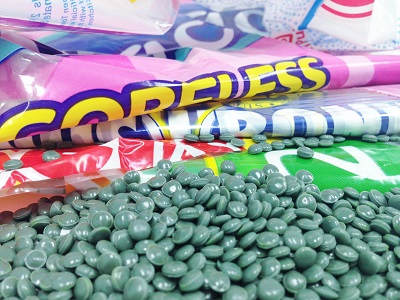
The die-face cutting produces uniform, round-shaped pellets which are ideal for reprocessing in extrusion. It is also higher in re-selling values comparing to the square-shaped pellets produced by traditional spaghetti type cutting.
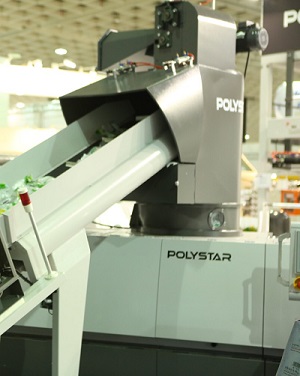
Polystar’s re-engineered design has enabled doubled degassing and high vacuum.
An improvement that Polystar has made recently on its pelletising system features automatic pelletising speed adjustment, in which the pelletising speed is changed automatically and constantly depending on the amount of material flowing through the die head. When more material passes through the die head the pelletising speed increases, and decreases again when the system detects that less material is going through. This results in even more uniform sized pellets despite of occasional feeding inconsistency at the front of the lin. Furthermore, manual adjustment of pelletising speed is no longer required.
This re-engineered recycling line Repro-Flex with the above improvements was first introduced in Taipei Plas 2014 and was presented again at NPE 2015 with live demonstration.
Expanding market
Polystar has recently commissioned it's fourth recycling line in Morocco in one of the largest injection producers Ingelec. Established in 1975 and based in Casablanca, Ingelec produces various injection moulded products for both local and international clients. With more than 1,250 employees, the company produces a wide range of product such as voltage switch gear, suitcases kits, accessories for IT Enclosures and many others.
The Polystar recycling line provides a flexible solution for the producer to recover its in house waste including ABS, PC, PA66, PC and LDPE, both rigid waste from injection, blow moulded and film waste from packaging. In March, Polystar will install another 500kg/hour film recycling line in the top film producers in Morocco Dounia Plast, which has already been recycling 2 tonnes of post-industrial LDPE film per day and will increase capacity with the additional Polystar recycling line.