
 Access
 Login/Register
 Supplier Login












FOOD and the environment are a shared resource and their use and management are unmistakably intertwined. This makes sustainable practices a shared responsibility worldwide. Despite gaining momentum, the green approach specifically in recycling and recyclability is still lagging in the F&B sector. Now more than ever, brand owners, associations, suppliers, outlets, consumers and even municipalities need to work closer and smarter together.
Much can be learned from countries in the West, although there remains more that can be accomplished. Failing to incorporate recycling into packaging choices is costing major US brands $11.4 billion in potential savings, according to a report released by US-based environment advocacy groups Natural Resources Defense Council (NRDC) and As You Sow. Waste and Opportunity 2015, a 62-page report analyzes the packaging practices of 47 US-based fast food chains, beverage companies and consumer goods and grocery companies against source reduction, recycled content, recyclability/compostability and in boosting materials recycling.
Packaging issues
Readily recyclable materials such as paper (including coated paper), polypropylene (PP), and polyethylene terephthalate (PET) are among the commonly used consumer packaging materials in the quick-service restaurants (QSRs). Levels of recycled content are significant, but are mostly paper-based. McDonald’s in particular uses 33% postconsumer recycled content in paperboard sandwich boxes, while Starbucks uses 10% in coffee cups. While majority of packaging used in the sector is mechanically recyclable, increasing recycling rates is stifled by concerns of food-soiled and plastic-coated materials, the need for material development or expansion, and corporations’ lukewarm approach to package recycling.
The report encourages QSRs to work with paper recyclers to use more postconsumer packaging into mixed-paper bales for recycling. It adds that “paper mills concerned about plummeting rates of newsprint available for recovery, and other paper manufacturers (especially those using lower-grade fibers), may be able to use food service packaging to replace some of the lost recycled fiber volume. While food-soiled paper can be composted in commercial composting facilities, plastic coatings may be a concern, and commercial composting infrastructure that can handle these items is not yet in place in many locations.”
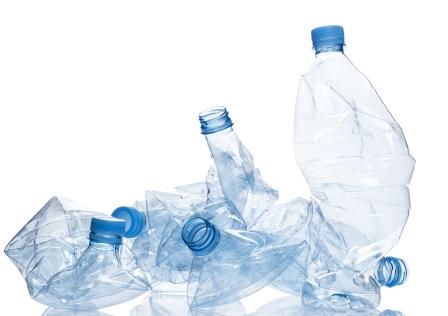
Empty water bottles © Yekophotostudio | Dreamstime.com
Working with municipalities
In terms of materials recycling, the study says “back-of-house recycling of readily recyclable materials such as corrugated boxes should be standard procedure at all QSRs as it is relatively easy to implement. Since the majority of QSR food is taken off-premises, brands also need to work with municipalities so patrons have curbside access to recycling and strategically located recycling bins in public areas. If brands work together to consolidate volumes of paper and plastic packaging collected on-site, they may be able to aggregate sufficient amounts to attract recycling in areas where it may not currently be economically feasible on an individual brand or location basis.”
Packaging for the beverage market is expected to hit $131.1 billion by 2019. The study notes that the biggest hurdle to increasing recyclability in this sector is the growing use of laminated pouches and other flexible plastic packaging for children’s beverages. It explains that Single-stream recycling and the use of materials such as shrink wrap on bottles contribute to a high level of product yield loss exceeding 30% for highly sought postconsumer PET, from curbside programs. Major beverage brands such as Coca-Cola, Nestlé Waters NA, and PepsiCo are each taking positive steps to boost bottle and can recycling. The report cites Coca Cola in particular for switching from pouch packaging to the more recyclable aseptic cartons for its Honest Tea line. Still, it says, most brands support neither a container deposit nor an EPR (extended producer responsibility) scheme to boost recycling.
Scalable options needed
“The industry still lacks agreement on a scalable alternative plan for achieving commitments already made by companies to increase recycling rates in the near term. Most companies seem content recommending a patchwork of individual actions, such as volume-based pricing, landfill bans, and mandatory recycling laws. While these measures can sometimes lead to increased collection, they have not been implemented widely or uniformly enough to impact national recovery rates.”
The report acknowledges that the Consumer packaged goods (CPG) and grocery companies lag behind in policy development, responsibility for postconsumer packaging, and demonstrable commitments to increase recycling of packaging. This is especially true in the area of harnessing flexible packaging.
“With no apparent strategy by companies that produce it or brands that use it to make it recyclable, these materials are likely to continue to be landfilled, littered, and sometimes swept into waterways, increasing the growing problem of plastic pollution in our waterways and oceans”.
In addition, “a Carton Council program to finance sorting facility upgrades and improve markets to make it easier to collect and recycle aseptic cartons (e.g. juice boxes) has increased the national availability of carton curbside collection, but actual recycling of these materials remains a challenge.
Commitments by Colgate-Palmolive and Procter & Gamble to make nearly all product packaging recyclable by 2020 raises hope for the sector though. As does Walmart’s pledge to increase use of recycled plastic content in packaging and products by 3 billion pounds in the same period. According to the report, this has the potential of creating new markets for post-consumer plastics, creating green jobs, and reducing greenhouse gas emissions and other pollutants.
Closing ranks
Andrew Behar, CEO of As You Sow, hopes the report will educate fast food, consumer goods and grocery companies about their similar responsibilities, and motivate them to set packaging recycling and recycled content goals for materials that they put on the market and work together in taking greater responsibility for financing and implementing practices that will boost packaging and recycling rates.
A similar call for partnership and an integrated approach in recycling was made earlier by Novelis. The rolled aluminum manufacturer is shifting to a closed-loop business approach that carefully manages materials and avoids what is describes as a “take, make, and dispose” model. As it does, it encourages wide participation from other aluminum suppliers, beverage and packaging companies, retailers and distributors, recyclers, municipalities, environmental groups and consumers themselves in promoting the use of more sustainable consumer packaging through aluminum recycling.
According to Novelis, sustainability drives brand preference as consumers want brands to be more sustainable, be responsible about recycling and use products with high recycled content. Such view is backed by a research it commissioned last year to understand consumer preference.
The study, which surveyed 3,031 respondents from the US, the United Kingdom and Poland, reveals that respondents see recycling as a shared responsibility but they look to companies to take a leadership role in helping solve environmental challenges. A total of 76% of those surveyed expect companies to reduce the amount of energy used in the production of a product or a service. In terms of packaging, 75% of respondents expect companies to reduce the amount of new raw materials used; 84% want information on whether packaging can be recycled; and 82% say companies should increase the amount of recycled material in packaging.
Recycling aluminum
Recycling aluminum saves 95% of the energy and emissions associated with the production of primary metal, according to Novelis. Aside from the fact that aluminum can be recycled with no degradation in quality, recycling just one aluminum can also saves enough energy to run a TV for three hours.
Since 2011, the company has invested approximately $500 million to expand its recycling network, doubling its recycling capacity to 2.1 million metric tons per year and raising its recycled content from 30% to 46%. Its goal is to use 80% recycled content by 2020. “This strategy will enable us to accelerate and capitalize on the sustainability potential of aluminum as a lightweight, infinitely recyclable metal and to dramatically reduce the embedded carbon in our products,” explains president and CEO Phil Martens. “In an increasingly energy- and carbon-constrained environment, we are convinced it will be a key source of competitive advantage for our company–and for our customers.”
In 2013, the company launched evercan, a 90% recycled aluminum beverage can, which is 30% pre-consumer and 60% post-consumer. Currently, the average aluminum drinks can only uses 55% recycled content. The company contextualizes evercan’s impact and sustainability benefits, in three scenarios:
- If everyone in the United States drank only beverages in evercan, the greenhouse gas savings would equal the carbon footprint from electricity use in half a million homes for an entire year.
- If everyone in Europe drank evercan beverages, it would save nearly 5 million oil barrels worth of carbon emissions per year.
- If just one family of 4 makes the switch to drinking evercan beverages for 1 year, it would save carbon emissions equal to an average car passenger vehicle driving nearly 100 miles from New York City to Philadelphia.
In October 2014, Novelis opened the world’s largest aluminum recycling center adjacent to its rolling mill in Nachterstedt, Germany. The $258-million (€200 million) recycling center will process up to 400,000 metric tons of aluminum scrap annually, turning it back into high-value aluminum ingots to feed the company’s European manufacturing network. The new plant in Europe, brings the company’s recycling operations to four regions including Asia, North America and South America.
Recycling plastics
For its part, the Association for Postconsumer Plastic Recyclers (APR) released last year its Design Guide for Plastics Recyclability as a reference for package designers, engineers, brand managers, and decision makers. Focused on the most commonly reclaimed postconsumer packaging items such as PET, polyethylene, and polypropylene bottles and containers, the design guide discusses how package design for such materials might impact conventional mechanical plastics recycling systems; be improved to avoid recycling problems; and be optimized to make plastic packages more compatible with current recycling systems.
Aside from providing best practices used in manufacturing caps and closures, inks labels, colorants, and additives/layers/fillers, the technical guide also identifies possible contaminants of the recycling stream. These include ground silicone that are hard to wash away and can remain during melting and extruding pellets; inks that spall and bleed in hot caustic water; and tamper-resistant or tamper-evident sleeves or seals as they may not completely detach from the bottle, or are not easily removed in conventional separation systems.
In particular, the APR advises against tamper-resistant or tamper-evident sleeves or seals because if the label fully covers the container and is made of a different material than the container, the optical sorter, may misinterpret the correct resin of the container. It likewise cautions against additives on labels as it can change the float or sinkability of bottles, rendering good plastic lost as waste or contaminated. In addition, APR warns that use of nonmarket color of PET may pose problems at sorting and cause bottles to be landfilled.
Air Jordan VI Low