
 Access
 Login/Register
 Supplier Login












The world is at an environmental crossroad and faces many challenges that could impact future generations. These challenges need to be understood and addressed with responsible, sustainable solutions. One of the plastics industry’s major players - BASF, has actively pursued technological innovations to launch breakthrough products in response to market and social demands for the past decades. Hermann Althoff, Senior Vice President of Performance Chemicals Asia Pacific at BASF East Asia Regional Headquarters Ltd., shares with International Plastics News for Asia (IRNA) the company’s directions and how it meets the call for sustainability.

Mr. Althoff joined BASF in 1988 and has held various positions in the company. From 2011, he was in charge of the Global Business Unit Polyamide and Intermediates; a position he held for three years before returning to Singapore in 2014 to head the Global Business Unit Leather & Textile Chemicals. In August 2015, he transferred to Hong Kong as Senior Vice President, Performance Chemicals Asia Pacific.
IRNA: What was the role of BASF Plastic Additives contributing to the success of the plastics industry in the past decades?
Mr. Althoff: Plastic Additives are integral components in plastics contributing to the success of plastics in the process ability, in property modification and performance. Without plastic additives, plastics could not fulfil the performance requirement and the number of applications would be much smaller. BASF Plastic Additives, as a market leader, has been driving the innovation in products and applications for many decades and we are committed to continuous innovation and development.
IRNA: What has been the focus of BASF R&D activities in plastic additives that enables it to lead for so many years in the field?
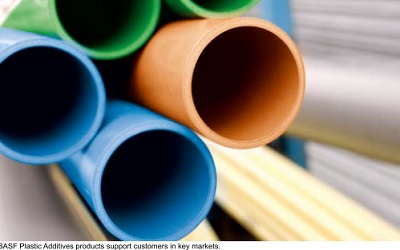
Mr. Althoff: BASF is a leading manufacturer, supplier and innovation partner of plastic additives. Our products support customers in meeting the specific needs of the key plastic markets in different industries such as automotive, agriculture, building and construction, electric & electronics, packaging, textiles and fibres.
In this aspect, BASF’s R&D is aligned with the future key applications for plastics. Our R&D focuses on making plastic materials more sustainable in terms of enabling more room for striking a balance between functionality, durability, and widening the options for plastic material processing window and new applications for the industries mentioned above.
For example, Our High Performance Light Stabilizer Tinuvin® is used in High Speed Train windows made of polycarbonate (“PC”) to give life time longer than ten years even under UV light exposure.
Another example, our Innovative Solution Irgastab® IS2515P provides stabilization during PE polymerization process, shorten production time (cycle time) in the production of Rotomoulding article such as water tank thus saving energy up to 30%. Moreover it provides UV protection up to fifteen years during the use of the articles under sun light exposure.
IRNA: How does BASF Plastic Additives stand apart from competitors?
Mr. Althoff: BASF has a strong global network in sales, innovation, technical service and marketing to support local countries in each region.
We have in total seven Production Sites, three Regional Application Centers, and four Global Competence Centers, located in different regions across the globe. In the Asia Pacific region, we have thirteen country sales offices to serve our customers.
This set up enables insight in local or regional markets that can be shared and used in other ones, enrich our customers with global knowledge and experience by capturing global market trend and technology development.
For example, Chimassorb® 2020 and Tinuvin® XT847 are recommended by key players in the industry to be used in their TPO resin for roofing application. Our Light Stabilizers provide long term UV protection up to ten years. First application was started in the United States, then it is also implemented in Asia as well with the support by our global and regional sales team and technical competence center.
Another example, the use of environmentally-friendly pesticide (sulfur burning) is becoming trend in Mediterranean area. Conventional Light Stabilizers are not stable under this chemical attack which lead to short life time protection of Agro Film. Tinuvin® NOR 371 and Tinuvin® XT100/200 are successfully established as Light Stabilizers which can provide stabilization up to three years for Agro Film even under heavy use of this type of pesticide. Leverage the BASF global network, resources and technical competence, this trend now comes to Asia. We are starting to implement this application in Yunnan China, Vietnam, Taiwan and India.

The worldwide presence of BASF at regions and countries also allows our global customers to qualify products manufactured at different sites to ensure consistent quality and reliability.
At BASF, we support customers by providing expert advice on applications and guidance on compliance with local, regional, and global regulatory.
Here is another example, we are working with one of our customers in Asia to apply FDA application for their resin. The customer uses BASF Anti-Oxidant for the stabilization of their SBC.
BASF has an unmatched product portfolio that comprises the largest range of antioxidants and process stabilisers, including phenolic and aminic antioxidants, phosphites as well as phenol-free stabilisation solutions to the plastic industry such as Irganox®, Irgafos®, and Irgastab®. Also our comprehensive light stabilizers portfolio encompasses leading Hindered Amine Light Stabilizers (HALS) and UV Absorbers (UVAs) such as Chimassorb®, Tinuvin® and Uvinul® for a wide range of polymers and applications.
In addition to the product portfolio, BASF also offers innovative “one-stop-shop” solutions in close cooperation with customers to help them solve their existing problem and to meet future challenges with our knowhow and experience.
For example, the polymer processing industry that requires additives in an easy-to-handle, free-flowing and low-dust product form. This is where BASF Plastic Additives Innovative Solution Blends step in to provide a complete stabilization package based on extruded or compacted mixtures of Irganox® antioxidant and other additives.
Another example, plastic parts in automotive exterior are often coated in order to match the color of the metal body part. Conventional stabilization provides UV light protection but with poor adhesion of the coating layer to the plastic part which reduce the life time of the plastic part and compromise the aesthetic appearance of the car. BASF Tinuvin® XT 850 provides excellent UV protection with good adhesion of coating layer as well as providing good acid rain resistance in more polluted environment.
IRNA: How does BASF help customer achieve sustainable production?
Mr. Althoff: As a market leader, BASF Plastic Additives is well positioned to meet requirement of various markets. BASF strives not only to be sustainable in our own production of additives, but also enabling our customers along with the value chain, especially our subsequent converting industries, to become more sustainable in their production.
For example, Our Innovative Solution Irgastab® IS2100G helps our customer to upgrade their LLDPE resin that enable their customer to produce more transparent film with 20% more throughput. Our customer in Asia increases their profitability and their customer (film converter) increase their production capacity up to 20% without additional investment.
BASF Plastic Additives develop solutions that enable our customers to save their energy consumption, use environmentally-friendly products (non-heavy metal), improve product life time which all will lead to reduce burden to our environment.