
 Access
 Login/Register
 Supplier Login












It’s not very common knowledge, even within the global plastics industry, that Borouge has long been an advocate of sustainability. Well before “sustainability” became a buzzword, the polymer producer decided that its activities should only bring positive benefits to society.
Laurence Jones, vice president of Marketing Centre for Film & Fibre at Borouge’s Marketing & Sales Company, has misgivings about buzzwords, and worries that when something becomes a buzzword it doesn’t necessarily draw the right response it should – especially when “sustainable” and “plastics” are in the same phrase.
“What Borouge decided years ago is that this has to be a sustainable business, and it's not about making money, it’s about doing something good for society.” said Mr. Jones. “You're talking to people who have an emotional response to what's going on with plastics. Then, we come along with science and buzzwords, and they say, ‘Oh yeah, you're a scientist,’ and then stop listening. I put my white lab coat and my safety glasses on, immediately they get bored and fall asleep,” he explains further.
There would be far more impact if one is to talk passionately and manifest enthusiasm about one’s beliefs and principles. “This is why when we think about sustainability, it’s all about getting people's emotions more driven towards doing the right thing,” he says.
It was with this sense of enthusiasm that Mr. Jones told International Plastic News for the Middle East & Africa (IRNE) about the six global challenges that Borouge has identified and will continue to address through new products and technologies: Environment, Water, Energy, Healthcare, Food, and Waste.
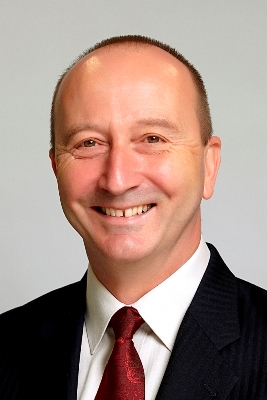
Mr. Laurence Jones
On the environment…
Borouge was the first company in the Middle East to sign on to the responsible care charter and remains very much driven towards having very low emissions, zero spills, and zero flaring goal, and highly energy efficient and water efficient plants. “So everything we do we gear towards these challenges,” Mr Jones affirms.
“People are concerned about plastics coming from non-renewable resources, but less than 4% of what’s pulled out of the ground in the form of oil or oil derivatives ends up being used as plastics,” he says. “But the use of plastics in packaging, automotive or airplanes actually reduces fuel consumption and energy consumption, reduces carbon footprint overall anywhere between three to seven times the carbon footprint of the actual plastic article itself.”
On water…
More than a billion people in the world don’t have access to clean water, and two billion don’t have access to proper sanitation. In their pipe business, Borouge has seen that high performance PE pipes are necessary to deliver drinking water more efficiently and more sustainably.
“It was interesting to see that when the earthquake occurred in Christchurch a couple of years ago, all of the water pipes were destroyed apart from the polyethylene pipes. These survived because they’re more flexible, they can take more impact,” Mr. Jones relates. “And it’s very clear that polyethylene pipes are a very sustainable solution for delivering clean drinking water.”
On energy…
Borouge knows that energy is normally produced well away from where it's used, so you have energy generation nowhere near the urban centre where it’s needed, and utilising its expertise in cable technology. “Our cable business is very much driven towards efficiently transferring energy from where it’s produced to where it’s consumed with minimal losses along the cables,” says Mr. Jones.
Traditionally, he adds, long distance cables have been AC cables often with no insulation around on overhead pylons. “We would prefer to see cables buried, which means you have to insulate them to prevent losses, and this is what Borouge is very good at in this cable business.”
Working together with Borealis, they have also developed a way of making these transmission cables with DC, which means you can have much better transmission of energy with less losses. It used to be difficult to insulate that with a polyethylene-based insulation, but this can be done today, thanks to the innovations that’s been going on in the innovations centers in Borealis in Europe.
On healthcare…
Plastics deliver so much into the health industry, and contribute to some extent towards making healthcare more affordable. “The health industry could not survive without plastics today,” says Mr. Jones. “But you also need to be able to do it in a way where the plastics are safe for use. So all our polyethylene, polypropylene grades for the health industry are FDA-approved from the procurement stage to the processing stage, using only very clean additives from antioxidants and so on, to make sure they’re very clean polymers.”
On food…
“The fifth challenge is very much something which is important to me,” Mr. Jones admits.” If you project to 2050, if you look at what futurologists have said, there's one futurologist called Raymond Hammond, I think his name is, who said if we don't change the way that we manage food; by 2050 we will need two planet earths to feed everyone.”
Mr. Jones stressed the need to produce more food and waste less. “And this is where our greenhouse comes in. We know we can produce higher crop yields and we're also doing innovation work to increase the amount of light penetrating our diffuse-light greenhouses and much more work on how to make them longer-lasting. We truly believe that crops should be grown in that way: with diffused light greenhouses, with irrigation pipes for water, for fertiliser, because we must produce more food.”
The other thing took place two years ago when the world reached a milestone where more than 50% of the global population now lives in urban areas. So everybody's moving into urban areas moving waste where food is produced. “And we know from studies done in Europe that in areas where food is packaged, or is not packaged, up to 50% is lost between where it's produced and where it's consumed --and even with the terrible consumption behavior we even waste it in the home where we leave it in the fridge door and throw it away,” Mr. Jones said.
Borouge very much agrees with the concepts of REACH. “If you're going to use plastic packaging and human beings come into contact with it, it must be safe. I'm absolutely am convinced about this. We know that if you do package food, less than 3% is lost. So 50% versus 3% is already a major difference in how we have to manage the food chain later. I've seen one study, and I have the data somewhere, where it shows if you take the packaging and give it a nominal carbon footprint of 1 if you get 1% loss -- and this is a study done on meat, on beef -- 1% loss increases the carbon footprint to 3. So it triples the carbon footprint if you lost one percent if you go to 3% you lose almost 9, the carbon footprint increases towards 9. So for me packaging has to be 100% reliable and there must be zero losses, but it still has to be done with less polymer, less use of global resources, but it must have high packaging integrity. And also of course plastic packaging, we know that if you use plastic rather than metal cans or cardboard, by reducing the weight, you're reducing the distribution and consumption of fuel,” he explains.
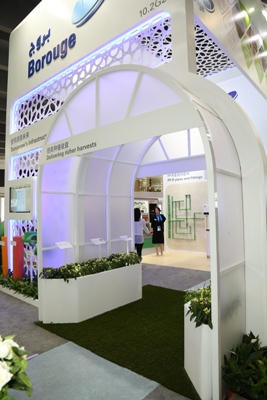
Borouge and packaging designs…
Borouge, according to Mr. Jones, on enhancing packaging designs. “I mean all of our packaging designs are designed to have the maximum impact, the highest strength but with the minimal use of polymers. And the next generation Borstar that we're coming along with-- Borstar today, in film, you can typically downgrade 15-20% from traditional materials. The next generation, we believe we can down gauge by an extra 20%. It's a material called BorShape. We're testing it right now from Europe. This material is amazing. It's a terpolymer system, so it's a Borstar terpolymer, and this is the next generation of packaging for us. We're looking at other terpolymer Borstars to complement all the layers of the packaging you're going to need. So the future is on its way,” he states.
Next year, Borouge is bringing BorShape from Abu Dhabi into the marketplace.” We're bringing it today from Europe. So in the coming two or three years, more changes to come. We're not standing still, innovation continues,” Mr. Jones adds.
On the sixth global challenge…
The sixth challenge – waste - is the one that bothers Mr. Jones the most. “This is why people hate plastics and why people want to ban plastics. It's because we do not manage waste. When I do these four lectures where I talk to, I've met with environmental groups and so on, what I've showed them is they really need plastics if they want to have a positive impact on the environment, then plastic plays an important role. But when you waste it, allow it to just go into the environment then you have problems; this is where the general public gets impacted, this is what they see. Their natural reaction is ‘Get rid of plastics because it's horrible in the environment.’ What we really should be doing is managing waste. We shouldn't casually throw away something that's so valuable. It is being taken out of the ground. It is coming from fossil fuel,” he elaborates.
“We have to grow food. So in order to change peoples' perception, we have to manage waste. We cannot keep thinking that we can do without plastics, we really can't, and we shouldn't. So I truly believe this. And when I talked to environmental agencies they're starting to see. I had a long discussion with an environmental agency in Abu Dhabi for instance, where our headquarters are. And originally, they were convinced they wanted to move all plastics out of the value chain. Now they realise: A, they can't do it, B, they don't want to. But they do have to manage waste. And that's to me, the biggest challenge especially on the packaging side, because that's the biggest impact we have with people. We have to manage waste properly,” Mr. Jones adds.
Initiatives and directions…
Borouge is now working directly with brand owners to stress the importance of its solutions. “Traditionally, in our industry, we talk only to plastics converters but now we talk directly with major brand owners. And the main reason being, although it's our plastic which is appearing in waste streams, the brand owners' name is printed on them. So they have an interest in making sure that they are doing the right thing from a sustainability perspective. What we're trying to do with them is to design packaging, which is, if you can design from the early stages, and with rigid packaging, you could do this. You can design reusability.
The best form of recycling is to reuse it because it takes no energy. If you can't design reusability in, because flexible packaging is very important for further lightweighting for transportation and so on, then you should design recyclability into it. Today if you look at the stand-up pouches and stuff like this, this is typically lamination between polyethylene and say polyester or polypropylene. It's very difficult to recycle something that has two different plastics stuck together. So we're trying to work with the global brand owners to redesign that package being 100% polyethylene-based; then it could be completely recyclable. It's not easy because you need that stiffness, you need the strength. Our innovation processes, we're working very hard to make it 100% recyclable polyethylene. Exciting stuff isn't it?” according to Mr. Jones.