
 Access
 Login/Register
 Supplier Login












The new industrial revolution has swept the global industrial sector, the plastics industry included. “Industrie 4.0” or Industry 4.0 refers to the fourth industrial revolution and stems from a high-tech strategy of the German government to promote the computerisation of manufacturing.
First used in 2011 at the Hanover Fair, Industry 4.0 is expected to enhance the competitiveness of the European industries with additional €550 billion over five years in revenues, according to a study from PwC finds. To transform to the industry 4.0, the investment will be high, at €140 billion per year until 2020. More than the revenues the strategy is seen to result in increased average efficiency of 3.3% annually and reduction in costs by 2.6%.
Industry 4.0 involves the deployment of ‘industrial internet’, or digitalisation and automation of the industrial process. Within this context, both the vertical and the horizontal value chains are to be integrated and the connection of people, machines and systems in real time, highly automated systems. Industry 4.0 is networking of all relevant technologies in an Internet of objects, services and data. This integration aims to meet the overall goal of improving production to be able to provide customers with fast and efficient responses to customer demands.
The PwC research also found that investment into the transformation of the value chain across European industrial companies will be €140 billion per year until 2020. Following these high levels of investment in the digitalisation of the value chains, the companies surveyed by PwC will see much of their transformed into an 'industrial 4.0' standard in the coming five years. Information and communication companies are now at 27% digitalisation and moving towards 80% by 2020. Electronics and electrical systems will see the greatest digitalisation of their value chain, at 89% by 2020. In terms of companies by size, larger companies with revenue in excess of €5 billion will see the biggest growth, at 92%. Across all industries the average by 2020 is 83%.
Transforming the industry
Industry 4.0 is an ideal approach to production in which each aspect or component is networked according to the model of the Internet to be able to operate a “smart factory” with a high level of flexibility, efficiency and enhanced productivity. A computer system will enable to control the production processes with production data recorded and properly achieved. This can definitely increase the efficiency of a company and reduce its costs.
For the plastics industry, Industry 4.0 is not new as big players have embarked on high-tech production and automation prior to the launch of this latest industrial revolution. “Smart manufacturing” has become a buzzword and a growing number of companies have been moving towards this goal by innovating and launching new technologies that will raise overall production efficiency through digitalisation and automation.
Wittmann Battenfeld manufacturing plant in Kottingbrunn, Austria took the limelight in a recent tour where the concept of Industry 4.0 was brought to the fore in a number of seminar presentations. The Wittmann Group has been designing and acting as a ‘one-stop-shop’ for all the equipment needed in an injection moulding cell, automation, materials handling, temperature control and other related equipment in the plastics production process.
At its event, MacroPower Days, the big-tonnage injection moulding machines of the company were demonstrated along with other special products and services of Wittmann Battenfeld GmbH. The company also stressed the benefits of Wittmann 4.0, its version of Europe’s Industry 4.0 — where all machinery, production and quality information is linked seamlessly together, integrating and containing relevant data so that the equipment can self-adjust. Wittmann has spent years developing its interface – a special requirement to enable efficient performance of its injection molding machines, robots and other equipment. The company is set to make Wittmann 4.0 available in October.
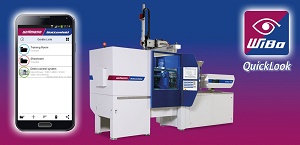
Wittmann 4.0 links seamlessly together machinery and production information for efficient performance.
Networked machines and processes
With its automated Allrounder injection moulding machines, the freeformer for additive manufacturing and own IT solutions such as the ALS host computer system, Arburg is also embracing Industry 4.0 as it evolves into a system supplier for networked production in the digital factory. Industry 4.0 is now directly affecting Arburg, its customers and the entire plastics industry. The networking of all technical components and production data required for a manufacturing process as well as end-to-end production traceability play an important role.
Arburg is to present itself beyond machine technology as a production system supplier for plastic part production at the Fakuma trade fair. One highlight is the customisation of mass-production parts by combining injection moulding and additive manufacturing, including integration with Industry 4.0 technologies. "We have been working on the subject of Industry 4.0 for some time now. With automated allrounders, the freeformer for additive manufacturing and IT solutions, we are increasingly developing ourselves into a production system supplier for integrated production in the digital factory", stresses Arburg's Managing Partner Juliane Hehl.
The Arburg host computer system (ALS) seamlessly documents all relevant process parameters and forwards these to a web server. A web page displaying all the relevant process data can be opened via the unique code using mobile devices. Each individual part can be seamlessly tracked in this way.
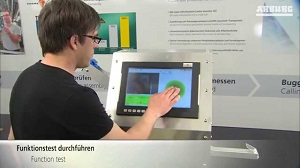
Arburg evolves into a system supplier for networked production in the digital factory.
Optimally realisable with PC control
Industry 4.0 already points toward intelligent, networked systems: previously separated production environments are combined to produce universal production worlds, which are partly of a physical nature, and partly attain a new functionality in the cyber space of web connectivity. The focal point in this development is the convergence of information and automation technology, for which Beckhoff laid the foundation already in 1986 with PC-based Control, and it still offers the optimum control architecture for future Industry 4.0 concepts.
In order to realise Industry 4.0 following a genuinely holistic approach, three aspects have to be implemented: horizontal integration across company boundaries, vertical integration through networked production systems, and integrated engineering throughout the product lifecycle. PC control offers the right solution for all of that, especially since it can be adapted very flexibly to varying application requirements: intelligence can be arranged in a hierarchically modular fashion under the central controller, but also decentralised, i.e. with equal rights if necessary.
In addition, there are hardly any technical systems today that cannot be operated by PC or at least be connected to a PC via software. Considering the great variety of manufacturing systems and technologies that are used in industrial enterprises, the key role of PC technology as an open platform and defacto industry standard for automation is obvious.
The openness and universality of PC Control can also be seen – entirely in the sense of Industry 4.0 – in current research work for the seamless integration of information areas that until now have been separated. Beckhoff is one of the core companies of the technology network “it’s OWL” (short for intelligent technical systems OstWestfalenLippe) which was distinguished in 2012 by the BMBF as a “Leading-Edge Cluster” and represents the first large-scale project supported in the context of Industry 4.0. Here, Beckhoff as consortium leader of the innovation project “ScAut” – one of the three key projects of the leading-edge cluster – is driving the integration of engineering findings into standard automation under the keyword “Scientific Automation”.
At Hanover Messe, Beckhoff presented its most powerful IT processors, meaning that the latest generation IT technology for automation applications. In the IT server field, many-core computers are used for particularly complex and demanding computing applications. The C6670 industrial server generation from Beckhoff makes this technology available for Industry 4.0 applications, too.
To accommodate the rising demands posed by the Smart Factory, with its highly intelligent machines and production systems, Beckhoff’s C6670 industrial server features 12, 24, or 36 processor cores and 64 to 2,048 GB of RAM, making the C6670 the ideal hardware platform for the “many-core control” concept, through which Beckhoff consistently pursues its centralised control philosophy. This means that not only PLC, Motion Control, robotics, and CNC functions, but also the Condition Monitoring and energy management functions of a Smart Factory are integrated into a single software system and executed on a single CPU. However, this immense computing power can only be utilised effectively if each core’s performance is fully leveraged by the TwinCAT 3.1 Automation platform.