
 Access
 Login/Register
 Supplier Login












HIS Majesty King Bhumibol Adulyadej of Thailand started the Royal Project in 1969 as a way to tackle opium production, deforestation and poverty in the northern hill tribes of Thailand. Rather than poppies, His Majesty felt the elevated terrain offered a cooler climate where more varied crops could be grown. Today, the King’s initiative has expanded and offers the locals a variety of ingredients to reduce their need for imported produce.
The project started out with peaches and a type of plum tree that only grows in the mountains, yet it wasn’t until recently that chefs at local restaurants discovered what a valuable resource they have at their disposal.
“Chefs have been quite happy with our products so far,” said Ritthee Bunnag, head of public relations for the project. “We listen to their feedback and try to grow what they suggest. Once or twice a year we invite them to come up to the hills to see what we are working on. Some of them are even advisors to the project."
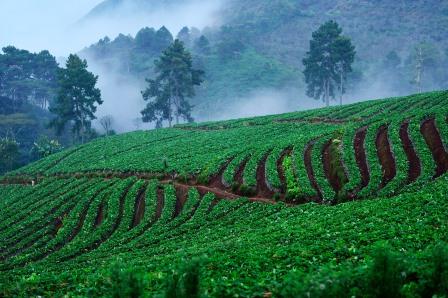
Rows of vegetables thrive in the northern hills where poppies used to grow
“A lot has changed since those early days, as the project tries to utilize science and research. We work with the Agriculture Department and a lot of Thai universities to test what we can grow in northern Thailand. Part of this is considering what products are imported as well,” he said.
“For example, we have programs in Chiang Mai, Chiang Rai, Phayao and Nan provinces, and the soil quality, elevation, climate and access to water differs in each province, so we have a lot to consider when deciding to introduce a new crop.
“We just had the Embassy of Peru give us some quinoa seeds because they want us to experiment with the grain. The project is also the only food producer in the world, to my knowledge, that employs someone with a PhD in strawberries, which our Japanese scientist holds.
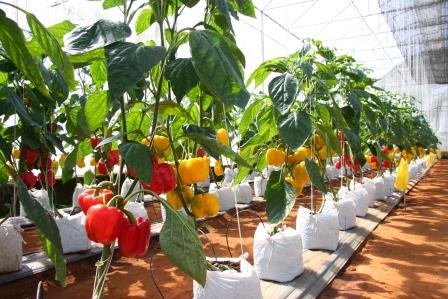
Well-tended vegetables are free from chemicals
“Recently we started to farm different animals for sale, including crayfish grown in rice fields. Our most ambitious scheme is to farm river trout, which still requires a lot more investment and is very labor-intensive as it requires a large plot of land and plenty of time.”
Though the Royal Project has expanded considerably since its inception, its products are still mostly produced by the hill tribes the program was created to assist. The project teaches the tribes how to grow the various crops and then buys the produce from them at a fair price, “because it can be hard for the farmers to do the marketing and sell at a good price,” said Mr Ritthee.
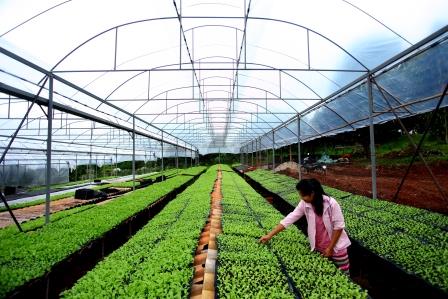
The initiative benefits from continuing research and programs that ensure the supply of new and better crops
The Royal Project made a name for itself through coffee and macadamia nuts initially, creating two brands for the former. But the relatively recent desire to buy local finally caught on in Thailand, which is when the scheme really started to form a bond with chefs here.
“I cannot think of a single reason to import fruits and vegetables,” said Nan Bunyasaranand, part owner and chef of Little Beast, one of Bangkok’s most highly regarded restaurants. “Growing up I remember hearing about the Royal Project because it had a shop at Or Tor Kor market, one of the top sites for produce in the country.
“For the price you pay, I think the quality we get from them is great. There are not a lot of purveyors that offer what they do. I have not made any special requests, but I know some chef friends that suggested they grow wood sorrel and chive flowers after our last visit to their facilities.”
Mr Ritthee said the project is certified to follow Good Agricultural Practice (GAP) standards, which is a global code rather than Thai, meaning its produce has found traction even in finicky foreign markets.
“We have our own laboratory that tests for quality before we ship products out, which is another selling point,” he said. “We run tests every day and on every lot. Customers know they are getting quality when they buy from us. Some of the tribes recently started growing organic produce.”
The project also aims to rehabilitate the environment around the highlands where the hill tribes live, where slash and burn agricultural practices were prevalent. Planting helps anchor the soil in deforested areas, reducing the likelihood of landslides.
Doi Kham is the Royal Project brand for its food items, and in the northern dialect the name means “golden mountain”. The idea behind the name is the locales where these hill tribes live will become more prosperous and sustainable if they switch to fruits and vegetables from opium poppies.
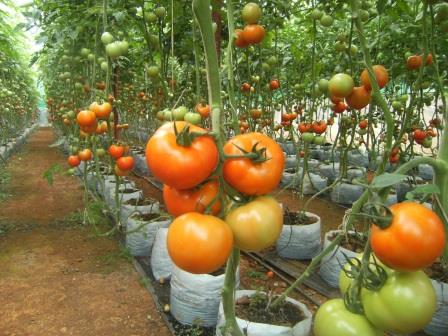
Local restaurateurs rave about the quality of home-grown produce such as these plump tomatoes
Doi Kham products includes fruit juices, herbs, water, mangos, strawberries, tomatoes, longan, lychee, guava, mushrooms, mulberries, passion fruit, limes, sweet corn, avocado, kiwi, basil, pussy willow, honey, soybeans and several varieties of rice, among others. All are produced without the use of chemicals.
But coffee has been by far the project’s biggest success story. It has two brands — Doi Tung and Doi Chaang — selling not only domestically but also exporting. Both are single-origin producers of Arabica beans, and rather than having the growers sell the green beans to others for processing, the Royal Project wanted the villagers to earn more money from advancing up the value chain. Both brands built their own processing, drying and roasting plants.
Doi Tung was able to earn Geographical Indication (GI) registration with the Thai Intellectual Property Department, a listing that adds value and strengthens the brand as no other coffee can use the term Doi Tung unless it is grown in a specific area of Chiang Rai.
The Royal Project Foundation runs four research stations and has 35 development centers that help 295 villages comprising 14,109 families. Its work has assisted some 85,000 rural and hill tribe Thais.
Finance for the projects was initiated by His Majesty himself before convincing the government and foreign agencies of the value of the scheme, leading them to contribute to it.
Nike React Element 87