
 Access
 Login/Register
 Supplier Login












The Centre for Economics and Business Research (CEBR) believes that China will finally eclipse the US in 2028, as the Asian giant's GDP rises to USD 33 trillion, compared to the United States' GDP of USD 32 trillion.
The global economy is set for unprecedented changes over the next two decades, which could see established developed economies lose out to emerging nations not just from Asia, but elsewhere as well.
CEBR notes that the forecast is focused on three elements such as real GDP growth, an inflation forecast and a currency forecast.
While the first two are likely to be accurate on an annual basis to within 1% or in some cases 2%, currencies have a way of wildly defying forecasters' predictions.
"The majority of the mega-trends incorporated in these forecasts are well established and, while the precise years in which changes of position are likely to take place can move backwards and forwards by as much as five to 10 years, the directions of change are well established," the consultancy said.
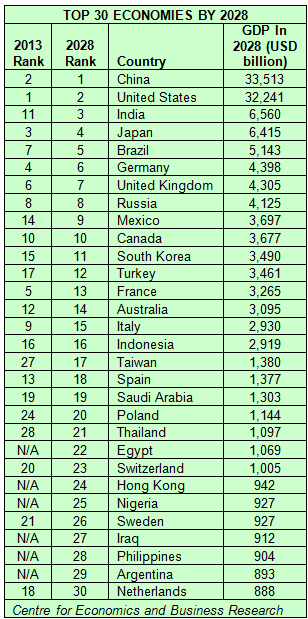
Saudi Arabia will predictably remain the Middle East's largest economy, its GDP nearly doubling from USD 718 billion in 2013 to USD 1.3 trillion by 2028, as its billion-dollar investments in the non-oil sector bear fruit.
The consultancy expects Saudi to become the 18th largest economy by 2018 and 2023 on oil-driven growth, but ease back to its current 19th position by 2028.
Egyptians might take heart from the prediction that by 2028, the country would emerge as the 22nd largest economy in the world. The country is currently stuck in a political vortex that it can't seem to get out of, but hopefully the authorities can resolve some of the key issues that are holding back the country.
Egypt's open economy, favorable demographics and strategic location within the key markets of Europe, Middle East and Africa should help the country push through difficult social and political reforms.
Another major surprise could be Iraq as CEBR looks past the massive political and sectarian challenges facing the country. Iraq is an oil powerhouse and has barely scratched the surface of its oil reserves.
While the country has ambitious plans to raise crude production to anywhere between 7-10 million bpd, most analysts believe Iraq will be far short given its infrastructure issues.
Of course, much will depend on the Iraqi government's ability to bring some sort of normalcy and security to attract the needed investment.
IRAN, UAE FAIL TO MAKE LIST
Iran has already slipped from 21st place in 2012 to 30th place as Western sanctions take their toll, and the country is unlikely to retain its place as other economies gallop ahead.
More interestingly, the UAE may not be able to maintain its position as one of the world's largest economies, despite a World-Expo-induced shot in the arm.
"The UAE rose from 30th position in 2012 to 29th in 2013 on the back of rising oil production and an economic recovery in the property sector," CEBR said. "But post 2018, the country is likely to fall back to 37th position in 2023 and 39th in 2028 as the consequences of weaker energy prices, lack of skills and education and failure to diversify start to emerge."
While some disagree with the CEBR report, the study follows the same growth trajectory as aNIKE