
 Access
 Login/Register
 Supplier Login












TAIDA Plastics Technologies (SINTD) is a fast-growing manufacturer of auxiliary equipment for the plastics industry. The company produces dehumidifier and drying combinations, feed conveyors, mixers, temperature controllers, crushers and robots. International Plastics News for Asia (IRNA) had the chance to talk to Mr. Shanhong Wang, Managing Director of TAIDA Plastics Technologies Ltd.-SINTD brand on the company’s growing range of products.
IRNA: TAIDA Plastics Technologies has been known for producing a wide range of auxiliary equipment for the plastics industry. What are your most popular products?
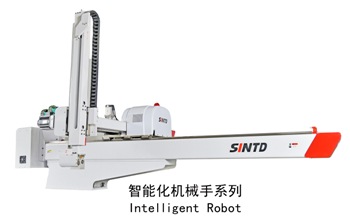
Mr. Wang: Industrial automation is unstoppable and in fact manufacturers would fade out of market if they did not adopt automation in their production in the very near future. Therefore, demand for automation is ever increasing. In the past few years, our automation series, such as Swing-Arm Robots, All-Servo Manipulators, Servo-Driven Robots have been gaining popularity. They are can be integrated to work with plastics processing machines to improve production efficiency. In addition, SINTD is experienced in supporting manufacturers to upgrade their traditional production into semi- or fully-automated system.
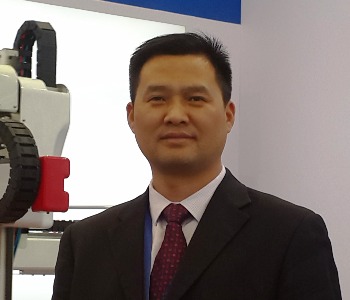
Mr. Shanhong Wang, Managing Director
SINTD automation series are highly adaptable, as well as easy to operate. For example, the Swing-Arm Robot equipped with Interactive HMI contains 8 configuration programs and 50 self-programming memory modules. Its system motherboard is high temperature-resistant and its aluminum-alloy moving parts are driven by world class pneumatic components to ensure high precision, high speed, high stability movement. The robot connects with an injection molding machine with double security clamping to guarantee safety.
IRNA: How was your production, sales and marketing performance in the past few years?
Mr. Wang: We have two production bases in China, TAIDA Plastic Technologies (Zhongshan) Co. Ltd in in Zhongshan city, China (Southern China) and TAIDA Plastic Technologies (Anhui) Co., Ltd in Anhui city, China (Central China). They serve customers in their own regions. In addition, we have distributors and service centers in 30 different countries. In 2015, despite the global economic slowdown, our sales revenue still reached RMB 300 million. This year we expect to have a significant growth with our aggressive marketing strategy.
For the past few years, we have expanded our market in Southeast Asia. In 2015, we made a 30% growth in terms of sales. We have sold a great number of our PET systems, dehumidifying and drying series, granulating and recycling series, weighing type mixing series and robots to Southeast Asian customers. In fact, ASEAN is one of the largest economic zones in the world. It is home to more than 600 million people and the most importance of all is that the market is growing fast. Therefore, we expect that we will continue to expand our export to the SE Asia in the coming years.
IRNA: Is there a specific strategy that the company applies to become competitive in your target markets?
Mr. Wang: As an auxiliary equipment maker, to win in the marketplace we must have consistency in quality and service so that the word-of-mouth marketing works. We usually have long-term customer relationship then we can expand our business sectors and penetrate into industry verticals. Some big injection molding machine makers, such as Husky and Demag learned that our auxiliary equipment have good quality with reasonable prices via word-of-mouth. Of course, we keep our customers because our products and services are always consistent.
IRNA: What are the trends in the auxiliary equipment do you see in the coming years? What features would be added to auxiliary equipment based on customers' demand and preferences?
Mr. Wang: Customers look for full automation solutions though everyone might have a slightly different definition of it. For sure the future auxiliary equipment will be highly automatic. This trend is unstoppable and also China government has offered tremendous support and incentives to the market and hoped to achieve the Made-in-China 2025 plan.
Nowadays manufacturers not only look for low-price equipment, but also high quality products that can save a lot of their production cost and time. The future auxiliary equipment will continue to be energy-saving and easy to use.
IRNA: Are there plans to expand? Please give details.
Mr. Wang: This year we will not expand our production bases or set up any other offices. But we will continue to invest our R&D to advance our product quality. In addition, we will continue to strengthen our remote technical support and remote monitoring systems to minimize any human malfunction and deliver fast responses to resolve customers’ issues.