
 Access
 Login/Register
 Supplier Login












GEA Food Solutions, part of the GEA Group is a renowned supplier of secondary food processing and packaging equipment. The company has been true to its commitment of ensuring improved performance, high quality and yield, as well as cost effectiveness through its solutions that have desirable impact on its customers' businesses.
In a recent interview with International Plastics News - Middle East and Africa (IRNE), Stefan Krakow, Product Manager Thermoformers at GEA Food Solutions provides an overview on the company's products, and the company’s position as a multifaceted supplier with strong focus on the Middle East market.
IRNE: What types of packaging equipment does GEA Food Solutions provide?
Mr. Krakow: GEA Food Solutions offers two types of packaging machines: the GEA PowerPak family horizontal form-, fill- and seal thermoformers and the GEA SmartPacker family of vertical form-, fill- and seal baggers. All packaging machine families are available with a range of capacities and add-on options to be able to cater to every need, from flexible businesses right up to very high-volume producers.
The main markets served are in the food industry, especially raw- and processed meat and poultry products, cheese, bakery products, sea food, fish, salads, fruits, snacks and confectionery. The GEA horizontal thermoformers are also widely used for non-food and consumer goods, including surgical supplies, technical goods and other products where a formed and sealed package is required.
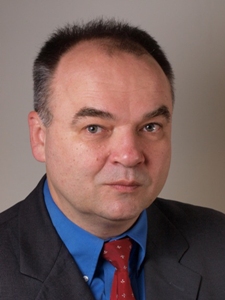
IRNE: GEA has prided itself for being a true solutions supplier. How did the company achieve this?
Mr. Krakow: Being able to supply more than just packaging machines, undoubtedly, GEA is a true solutions supplier. The full range also includes pre-scanners, slicers, weighers, printers, labellers, lane convergers and more end-of-line equipment.
The packaging machines are fast, reliable and engineered for very high machine availability (uptime). Because the machines are designed to seamless interface with each other, a complete line can be operated via a single control system.
IRNE: What add-on services does GEA offer to its customers?
Mr. Krakow: The most important add-ons for the packaging machines are printing and labelling solutions. This is driven by the increasing legal and commercial requirements to include production and traceability data, dietary information and 2D and 3D barcodes.
GEA offers integrated cross-web and in-line labelling solutions for pre-printed labels, and integrated printers (for example, inkjet and thermo-transfer) for creating ‘product identification on demand’ labels on the machine. The printers are sourced from leading global OEMs, and are fully integrated into the GEA machines and control software.
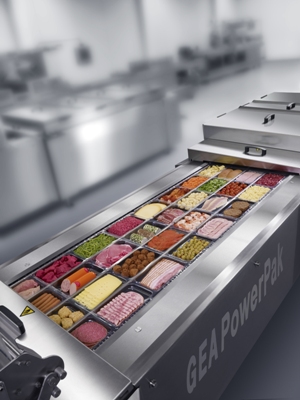
The GEA PowerPak
IRNE: How does GEA maintain high product quality and sustain its performance?
Mr. Krakow: Although both the thermoforming and labelling processes are well established technologies, GEA is constantly striving to improve performance. The main goals are to increase the machine efficiency and decrease the cost per pack. GEA has for example, developed automatic reject identification and ejection. Printing and labelling is an area where the potential for automation is constantly growing, and GEA’s hardware and software solutions help reduce manual involvement on the packaging line.
IRNE: What are GEA Food Solutions' unique propositions that set it apart from its competitors?
Mr. Krakow: The GEA Group is a global player in many processing industries and is one of the most multifaceted suppliers of secondary food processing and packaging equipment in the world. The segments cover farm technologies, mechanical equipment, process engineering and refrigeration technologies. In addition to the packaging equipment, the Food Solutions segment also manufactures machines for preparation, marination, further processing and slicing.
The overriding objective is always to improve customers’ operational and financial performance in terms of productivity, yield, quality and cost-effectiveness by supplying reliable and robust solutions. The products range from individual, stand-alone machines to complete processing lines, and are designed, developed, manufactured and tested in four European plants, two in Germany (Wallau and Kempten) and two in the Netherlands (Weert and Bakel).
IRNE: How does the company maintain a strong presence in the Middle East given its strategic importance?
Mr. Krakow: The sales and customer support organisation covers all corners of the world, and there is a strong regional presence in the Middle East, with local agents and partners who help the company better serve customers in the region better. This means there are no language or cultural barriers, and regional customs are known.
GEA has been active in the Middle East for many decades, and has built up a large team of application support experts who understand the products and processes that are important to the region. Conferences and exhibitions have proven to be an ideal platform for meeting customers and for showing the latest technologies. GEA strives to have functioning machines on the stand at Gulfood Manufacturing – one of the most important trade shows in the region – and has established many valuable relationships with the market.
IRNE: What material and environmental trends will GEA pursue in the future?
Mr. Krakow: Although traditional plastic-based films and materials are still used for most packaging applications, the availability of sustainable packaging materials is improving and the cost-performance ratio of these materials in packaging applications is getting better. GEA works closely with suppliers of bio-materials as well as with customers who wish to adopt the films to ensure the thermoformers and baggers perform as required.
The superbly equipped GEA Technology Centers in Wallau and Weert, where customers can test new packaging formats, materials and configurations, are also used by material manufacturers to try-out new films and verify their performance. Although GEA does not supply packaging materials to its customers – leaving them free to choose their roll stock, the company does provide help to ensure the selected materials support the extensive functionality of GEA machines.
IRNE: Is Research and Development done in-house or is it outsourced to external experts?
Mr. Krakow: Research and development into packaging machines is carried out in-house. Both the engineering and production takes place within the plants, so there is considerable expertise on-hand. GEA supports R&D into new packaging materials by sharing its applications know-how and facilities with manufacturers.
Other companies in the wider GEA Group also invest extensively in R&D, and they share their experience in related disciplines like fluid handling, making the company one of the most innovative and active in pushing the boundaries of technology.
Both the GEA Food Solutions plants in Wallau (thermoformers) and Weert (vertical baggers) have very long histories in packaging technology, and have led the industry for many decades. Both plants have also recently been extensively rebuilt to streamline production processes and make the state-of-the-art Technology Center facilities even more accessible.
GEA Food Solutions Germany GmbH
Tel: +49 6461 801 182
Website: www.gea.com