
 Access
 Login/Register
 Supplier Login












WHEN on a flight, perhaps least on a passenger’s mind is the type of packaging in which his food will be presented. Maybe, but isn’t always a pleasure to be served a meal arranged well in its container, especially when the stress of flying is too much to bear?
For Scandinavian Airlines (SAS), enhancing overall customer satisfaction meant not overlooking the small details, like food containers, so it upgraded to a packaging that met all its specifications. In this case the new packaging is made of Incada, a multi-layered folding box board (FBB), which is not only lightweight, but may be barrier coated and finished to the required look and feel.
SAS now uses this box board for evening meals aboard the SAS Plus on almost all routes outside the Nordic region.
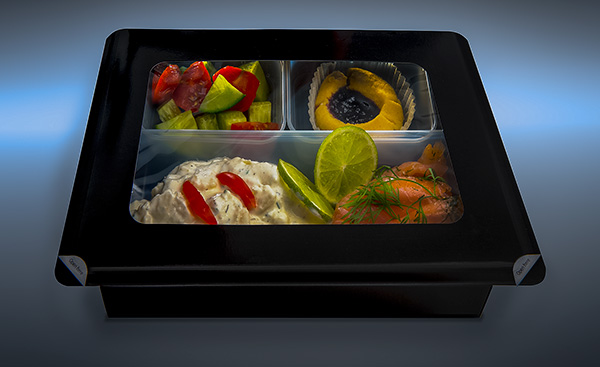
When SAS commissioned the development of a new form of packaging for its inflight meals, it chose the folding box board Incada from Iggesund as its base material
Photo courtesy of Iggesund
“In creating packaging for inflight meals you must take many factors into account,” said Gustaf Öholm, senior manager, Onboard Concepts, Services & Sales at SAS. “The packaging must have low weight, present the food well and feel good in the hand. It must be easy to open, and of course it must preserve the intentions of our kitchen up until the food reaches the passenger.”
Another new feature is that all the contents – apart from one piece of chocolate – are now being produced at the same place by a dedicated team. SAS believes this will raise both the quality and quality consistency of the meals.
The airline’s packaging supplier worked together with Elanders, which previously developed a compostable and lightweight packaging for Malmö Aviation.
From sustainable sources
“We chose Incada from Iggesund because of its stiffness and we coated the inside with a barrier of black-dyed polyethylene. The packaging’s outside was printed black and we then put a lot of effort into finding a transparent film that captured a minimum of condensation in order to create the best possible visual impression of the food,” explained Tony Norén of Elanders.
Incada is made at Iggesund Paperboard’s mill at Workington, England. There, Iggesund has radically changed its energy supply from fossil natural gas to biomass. The mill’s new CHP power plant is the result of an investment of £108 million, and the reduction in fossil emissions is the equivalent of taking 65,000 cars a year permanently off the road.
“Of course the environmental aspect is also an important factor in our decision,” Gustaf Öholm concludes. “Obviously it’s important to us that our food packaging has a high standard from an environmental perspective.”
Paper cups with metallic feature
IGGESUND Paperboard also created a large cup with a double-walled construction that is common on the market. This construction makes it possible to use one material inside the cup and another for the outer wall, to function as both a heat shield and a brand carrier.
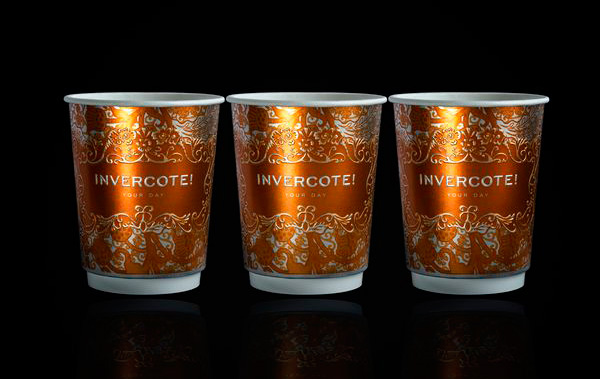
The Invercote cup is printed in one colour and features an embossed pattern and message
Photo courtesy of Iggesund
“For the cup’s inside we chose Invercote coated with polyethylene (PE) and for the outside we used Aluvision, which is Invercote extrusion coated with a thin layer of aluminium foil plus PE on top of the foil,” said Anna Adler, who is in charge of the project for Market Communications at Iggesund Paperboard. “We wanted the metallic feature in order to achieve elegance and shine even though we only printed with one colour, vintage orange.”
The project used an ornamental pattern that framed Iggesund’s Invercote brand. The plan was to cover everything, with the exception of the pattern with the orange colour, and then emboss the pattern and product name. The Swiss toolmaker SMR Stanztechnik AG supplied the high-precision embossing tool. The printing was then handled by the Italian paper cup specialists SDG, Scatolificio del Garda S.p.A.
“We did a number of tests to find out how much we should emboss but finally decided to emboss the entire pattern and brand name,” said Iggesund’s technical service manager, Alex Guglielmi. “It was interesting to see how embossing made the metallic tones that weren’t overprinted with orange really shine. A real eye catcher.”
Matching the printed and embossed areas was a real challenge. To avoid any misregister, the number of cup blanks per printed sheet was reduced from 27 to 24.
“Invercote has fantastic dimensional stability but sometimes it’s better to be on the safe side,” Mr Guglielmi said. “Instead of going with 27 we decided to be cautious and only do 24. It’s still a fantastic result for anyone who wants elegance and a visual impression that can convey a brand.”
The paperboard’s printability and ability to be finished to a high level of elegance are not the only reasons why Iggesund believes in a renaissance for paperboard-based beverage cups. Competing materials such as traditional plastic or polystyrene foam cups create a much higher carbon footprint than a cup made of paperboard with a thin PE coating.
“A cup made of PE-coated Invercote has a carbon footprint that is scarcely a quarter the size of the one left by the same cup made of plastic – just comparing the weight of the materials used,” Ms Adler emphasised. “By that measure alone, the paperboard cup is the clear winner. If you add the existence of efficient recycling systems and the fact that the stored bioenergy can finally be recovered, paperboard is an outstanding choice of material.”
Iggesund perceives long-term business opportunities for such a product, not least in the U.S., where debates continue over the impact of polystyrene foam cups on the environment. A number of American cities aim to stop the use of polystyrene foam materials in beverage cups and catering packs.
Nike news