
 Access
 Login/Register
 Supplier Login












STEVIA, the plant-based sugar substitute is expected to redefine the market as more manufacturers turn to it as the ingredient of choice amid efforts to reduce sugar and artificial sweeteners in many products.
PureCircle, a global supplier of high-quality stevia products, reported a number of product launches with stevia worldwide during the first quarter of 2015. About 60% of the products were for new food items while 40% were for beverages. The company forecasts that food and beverage companies worldwide will be launching an estimated 3,000 products with stevia by the end of this year.
In the Asia Pacific, stevia is used in snacks and beverages such as ready-to-drink tea, acidified milk, and yoghurt drinks.
Stevia companies are expanding production and improving product lines amid rising sales. Increased adoption is driven by the emphasis on health, specifically less sugar in foods, balanced by a bit of indulgence as reflected in mid-calorie versus zero options. In addition to sugar reduction, naturalness and cost savings are the other major factors.
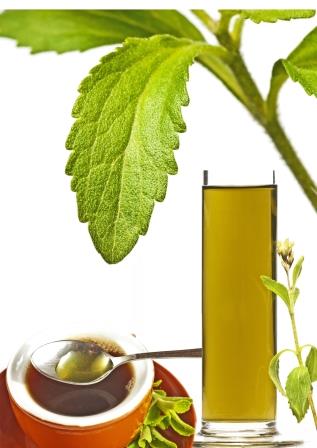
Stevia rebaudiana © Jochenschneider | Dreamstime.com
Big names such as Coca-Cola Company have started using stevia in their products. The Coca-Cola Life, the first version of the company’s popular soft drink to use the ingredient, reflects the company’s global commitment to provide an expanded selection of reduced, low-, and no-calorie beverage options. The Coca-Cola Life has 35% fewer calories than leading colas.
Improving product performance
Until now the adoption of stevia as a natural sweetener has been hampered by its bitter, licorice-like aftertaste. Even high-grade stevia extracts such as Rebaudioside A 98 and Rebaudioside A 99 from Sunwin Stevia International Inc. have not helped address the problem.
The company’s enzyme-treated stevia can effectively reduce, if not eliminate altogether, natural stevia’s bitter aftertaste. The product involves adding glucose to stevia extracts using α-glucosyltransferase and requires a special treat stevia seed to grow a special stevia leaf.
Sunwin Stevia, a provider of high-quality stevia extracts, has submitted a patent application for the enzyme-treated stevia products. It is currently the only company in the world that offers such advanced products on a commercial basis.
CEO Dongdong Lin said the company expects demand for the enzyme-treated stevia products to rise substantially in the years ahead.
“We launched the revolutionary products in 2013 and they have been receiving wide acceptance in the US by our customers. The new patent will protect our intellectual rights for our advanced enzyme-treated stevia products. We believe our enzyme-treated stevia products will be a mainstay in the industry and will dominate the global stevia markets for years to come,” Ms Lin said.
The Sigma-D from the global R&D team of PureCircle reduces the licorice aftertaste and lingering sweetness. The product, which is designed for dairy formulations, performs closer to sugar in taste applications and has a clean sweetness profile, according to the company. It enables up to 80% sugar reduction in end products.
Continuous product development
PureCircle demonstrated how to achieve the correct stevia composition and obtain the proper formulations for different products using its latest innovation, the Stevia 3.0, at the 20th International Food Ingredients & Additives Exhibition and Conference (IFIA 2015) in Tokyo, Japan.
The Stevia 3.0 provides a customizable approach to match different formulation optimization requirements, reduce calories, and generate cost savings.
Evolva, which supplies innovative and sustainable ingredients for health, wellness, and nutrition, is collaborating with Cargill to produce next-generation stevia sweeteners, steviol glycosides. The two companies will begin the engineering phase to convert an existing Cargill manufacturing facility for the production of the ingredients, which are expected to be commercially available in 2016. The engineering phase will have a total investment of US$3 million from Cargill and Evolva.
Evolva plans to exercise the option to obtain up to 45% stake in the business to commercialize the sweeteners, which was provided in the joint development agreement entered into by both companies in 2013.
Company CEO Neil Goldsmith acknowledges the firm’s close cooperation with Cargill over the past two-plus years. “The decision to commence engineering work reflects our mutual desire and commitment to bring great tasting, cost-effective sweeteners to the market as soon as possible. While there remain risks which could impact the timing of the final product launch and consumer uptake, we are confident in our joint progress,” Mr Goldsmith stated.
According to David Henstrom, vice president for Health Ingredients at Cargill, the sweetener will offer a new, delicious choice for reduced and zero-calorie food and beverages.
“Adding new production capabilities at our Cargill Blair facility fits strategically with our overall growth plan and is an exciting and necessary step as we prepare for the commercialization of a next-generation sweetener,” Mr Henstrom added.
For its part, Stevia First Corp., an agricultural biotechnology company that focuses on the industrial scale production of stevia, said it has successfully closed its previously announced financing with institutional investors. The Central Valley, California-based company has entered into a definitive securities purchase agreement to allow investors to purchase an aggregate of approximately $1.5 million of the company’s common stock in a private placement at $0.30 per share. It has also issued to the investors three series of warrants to buy additional shares of common stock.
Other companies such as PepsiCo (NYSE: PEP) are working with other sweetener alternatives. The maker of Pepsi, Mountain Dew, and many other popular soft drinks said recently it will stop using aspartame for its Diet Pepsi, Caffeine Free Diet Pepsi, and Wild Cherry Diet Pepsi.
The company will instead start using Sucralose, better known as Splenda from Johnson & Johnson, and acesulfame potassium, often called Ace K and is currently used in Coke Zero, in its drinks beginning August.
Vapormax