
 Access
 Login/Register
 Supplier Login












CAN tires make a difference in helping farmers boost their productivity and at the same time reduce their environmental footprint?
"Yes," according to Trelleborg, whose business focus is to seal, damp and protect critical applications in demanding environments. From its selection of raw materials through to the end user, the company is working toward a more sustainable tire future. Committed to reducing its own carbon footprint and those of its customers, it is investing considerable resources to do so.
"Cultivation accounts for more than 50% of the carbon footprint in the production of wheat and other cereals, and is therefore an important focal area as both consumers and farmers look at ways to improve sustainability," explains Lorenzo Ciferri, marketing director of agricultural and forestry tires within Trelleborg Wheel Systems.
Trelleborg Wheel Systems undertakes intensive research and development work together with the main tractor original equipment manufacturers, prompting sustainability consultants such as PE International, as well as the top agricultural schools in Europe, to create solutions that make a difference.
A major breakthrough came with the launch of the TM Blue™ tire concept to help farmers. The specially developed agricultural tires till the soil in a gentle manner through low compaction, which allows the soil to return to its original state, resulting in lower plant loss and higher crop yields. "With TM Blue, farmers get a higher yield and at the same time reduce their CO2 emissions," Mr Ciferri claims.
Lower carbon footprint
Compared with using other premium-brand tires, research at Technische Universitat Dresden shows that TM Blue contributes to a six percent reduction in the carbon footprint. Six percent may not sound like a huge amount, but it adds up. For example, the TM1000 HP BlueTire tires sold in 2013 will reduce CO2 emissions by up to 13,700 tons over the life of the tire. This is equivalent to the CO2 emissions from about 2,884 personal vehicles in the course of a year.
The wide footprint area, up to 13% wider than the market average, gives better flotation characteristics by distributing the load evenly across the footprint. The excellent traction capability of the TM Blue tires reduces slippage, which in turn reduces work time and energy dissipation, resulting in lower fuel consumption. In just one week of tilling, the tires can provide fuel consumption savings of 45 to 75 litres – and that adds up to cost savings for farmers as well.
Life cycle of tires
In addition to the actual use of agricultural tires, Trelleborg Wheel Systems is studying other aspects in the life cycle of tires, including raw materials, production, distribution and recycling. As expected, in its Life Cycle Analysis* (LCA), raw materials account for the bulk of the carbon footprint at 60 percent. "Two-thirds of our raw materials are based on fossil fuels, and we know this is going to have to change," Mr Ciferri says.
In the production process, which accounts for 30% of the carbon footprint, Trelleborg is analysing each step to see how it can be more environmentally-friendly. Water recycling, projects to reduce energy consumption, using renewable sources of energy and eliminating waste are some of the solutions. Less than three percent of waste material goes to landfill sites, and environmentally-friendly extender oils are used throughout the production process to prevent the risk of environmental contamination.
The LCA shows that distribution accounts for just three to five percent of the carbon footprint, but Trelleborg is addressing this area as well by manufacturing closer to its main markets. This will help reduce CO2 emissions caused by long-distance deliveries. Trelleborg's first North American manufacturing facility dedicated to the manufacture of premium radial tires for agricultural machinery is currently being built in South Carolina.
When it comes to the end of an agricultural tire's life cycle, Trelleborg estimates that an average of 40 to 45 percent of tire materials are recycled. "This portion increases significantly year to year, and it can potentially double within the next decade," adds Mr Ciferri.
Looking to the future, Trelleborg anticipates some big changes, especially when it comes to the use of raw materials. "We are improving the raw material phase through the eco-design of tires, selecting the right suppliers and materials," Mr Ciferri says. "We are already working jointly with our key suppliers looking into ways to reduce our dependency on fossil fuels by replacing them with other materials, such as advanced bio-polymers to replace synthetic rubber."
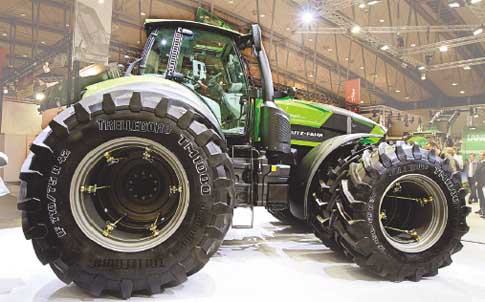
Trelleborg Wheel Systems undertakes intensive research and development work together with the main tractor original equipment manufacturers to achieve a 'sustainable tire future' with the TM Blue™ tire concept
Men Shoes - Originals