
 Access
 Login/Register
 Supplier Login












THE US Food and Drug Administration has released to the public its new Nutrition Facts label for packaged foods.
The labels have been updated to show new scientific information, including the link between diet and chronic diseases such as obesity and heart disease. By adding more information to packaging labels, the FDA hopes consumers will make better informed food choices.
Manufacturers must comply with the new labels by 2018, with the exception of companies with less than $10 million in annual food sales which are given until 2019.
Below are the highlights of the Final Nutrition Facts Label as shared by the FDA on their website.
1. A refreshed design
The “iconic” look of the label remains, but we are making important updates to ensure consumers have access to the information they need to make informed decisions about the foods they eat. These changes include increasing the type size for “Calories,” “servings per container,” and the “Serving size” declaration, and bolding the number of calories and the “Serving size” declaration to highlight this information.
Manufacturers must declare the actual amount, in addition to percent Daily Value of vitamin D, calcium, iron and potassium. They can voluntarily declare the gram amount for other vitamins and minerals.
The footnote is changing to better explain what percent Daily Value means. It will read: “*The % Daily Value tells you how much a nutrient in a serving of food contributes to a daily diet. 2,000 calories a day is used for general nutrition advice.”
2. Reflects updated information about nutrition science
“Added sugars,” in grams and as percent Daily Value, will be included on the label. Scientific data shows that it is difficult to meet nutrient needs while staying within calorie limits if you consume more than 10 percent of your total daily calories from added sugar, and this is consistent with the 2015-2020 Dietary Guidelines for Americans.
The list of nutrients that are required or permitted to be declared is being updated. Vitamin D and potassium will be required on the label. Calcium and iron will continue to be required. Vitamins A and C will no longer be required but can be included on a voluntary basis.
While continuing to require “Total Fat,” “Saturated Fat,” and “Trans Fat” on the label, “Calories from Fat” is being removed because research shows the type of fat is more important than the amount.
Daily values for nutrients like sodium, dietary fiber and vitamin D are being updated based on newer scientific evidence from the Institute of Medicine and other reports such as the 2015 Dietary Guidelines Advisory Committee Report, which was used in developing the 2015-2020 Dietary Guidelines for Americans. Daily values are reference amounts of nutrients to consume or not to exceed and are used to calculate the percent Daily Value (% DV) that manufacturers include on the label. The %DV helps consumers understand the nutrition information in the context of a total daily diet.
3. Updates serving sizes and labeling requirements for certain package sizes
By law, serving sizes must be based on amounts of foods and beverages that people are actually eating, not what they should be eating. How much people eat and drink has changed since the previous serving size requirements were published in 1993. For example, the reference amount used to set a serving of ice cream was previously ½ cup but is changing to ⅔ cup. The reference amount used to set a serving of soda is changing from 8 ounces to 12 ounces.
Package size affects what people eat. So for packages that are between one and two servings, such as a 20 ounce soda or a 15-ounce can of soup, the calories and other nutrients will be required to be labeled as one serving because people typically consume it in one sitting.
For certain products that are larger than a single serving but that could be consumed in one sitting or multiple sittings, manufacturers will have to provide “dual column” labels to indicate the amount of calories and nutrients on both a “per serving” and “per package”/“per unit” basis. Examples would be a 24-ounce bottle of soda or a pint of ice cream. With dual-column labels available, people will be able to easily understand how many calories and nutrients they are getting if they eat or drink the entire package/unit at one time.
Compliance dates
Manufacturers will need to use the new label by July 26, 2018. However, manufacturers with less than $10 million in annual food sales will have an additional year to comply.
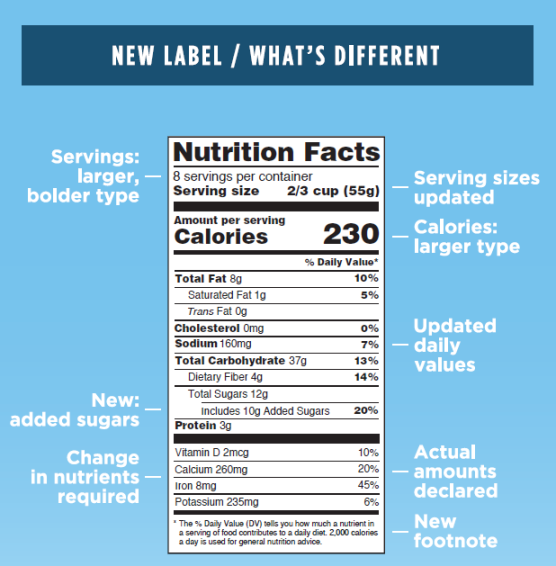
(Photo: US FDA)
Zapatillas Running Baratas