
 Access
 Login/Register
 Supplier Login












IN 1986, Abita started brewing craft beers in the United States. “When we started out, we didn’t know what we were getting into. In the first year, the brewery produced just 1,800 hectolitres,” explains David Blossman, Abita’s president. In 2011, on its 25th anniversary, the craft brewery was selling 146,000 hectolitres of beer and 10,000 hectolitres of root beer. In 2015, the figures rose to more than 177,000 hectolitres of beer and 11,000 hectolitres of root beer.
Variety of choices
Abita has eight principal brands offered all year round, namely Abita Amber, Golden, Light, Turbodog, Purple Haze, Jockamo I.P.A., Wrought Iron IPA and Restoration Pale Ale. Purple Haze, for example, is a wheat beer, to which after filtration fresh raspberry purée is added for a fruity aroma and flavour. Jockamo I.P.A. features 6.5 per cent abv with 52 bittering units.
Besides the eight principal brands, Abita also brews five seasonal beers: Bock, Spring IPA Red Ale, Seersucker Summer Pils, Christmas Ale, plus four harvest beers featuring freshly harvested ingredients from Louisiana like strawberries, satsumas or pecan nuts. In addition the brewery produces root beer, a soft drink based on yucca palm juice, vanilla and herbs with sugar from Louisiana sugarcane – redolent of the soft drinks produced in the 1940s and 1950s, before the soft-drinks manufacturers began to use corn sugar and fructose. These are complemented by ten of what are called “Big Beers”, such as Imperator, featuring caramel and chocolate.
In the “Abita Select” series, Abita premieres a new beer flavour every few months, available only on draught in selected restaurants and pubs. These beers include Bohemian beers, English bitter, Kölsch, Alt, barley beer, honey-rye or Rauchbier. To mark the 25th anniversary celebrations in 2011, Abita brewed the Vanilla Double Dog – which features caramel and chocolate malt plus natural vanilla beans. Another most definitely out-of-the-ordinary beer from the Select range was indubitably Imperial Louisiana Oyster Stout, with which Abita paid tribute to Louisiana’s seafood culture. The beer is brewed using various intensive malts and oat flakes, and lightly hopped with Williamette hops. For a special flavouring kick, fresh Lousiana oysters are also boiled in the wort, their saltiness giving the beer a very intensive aroma and mouthfeel.
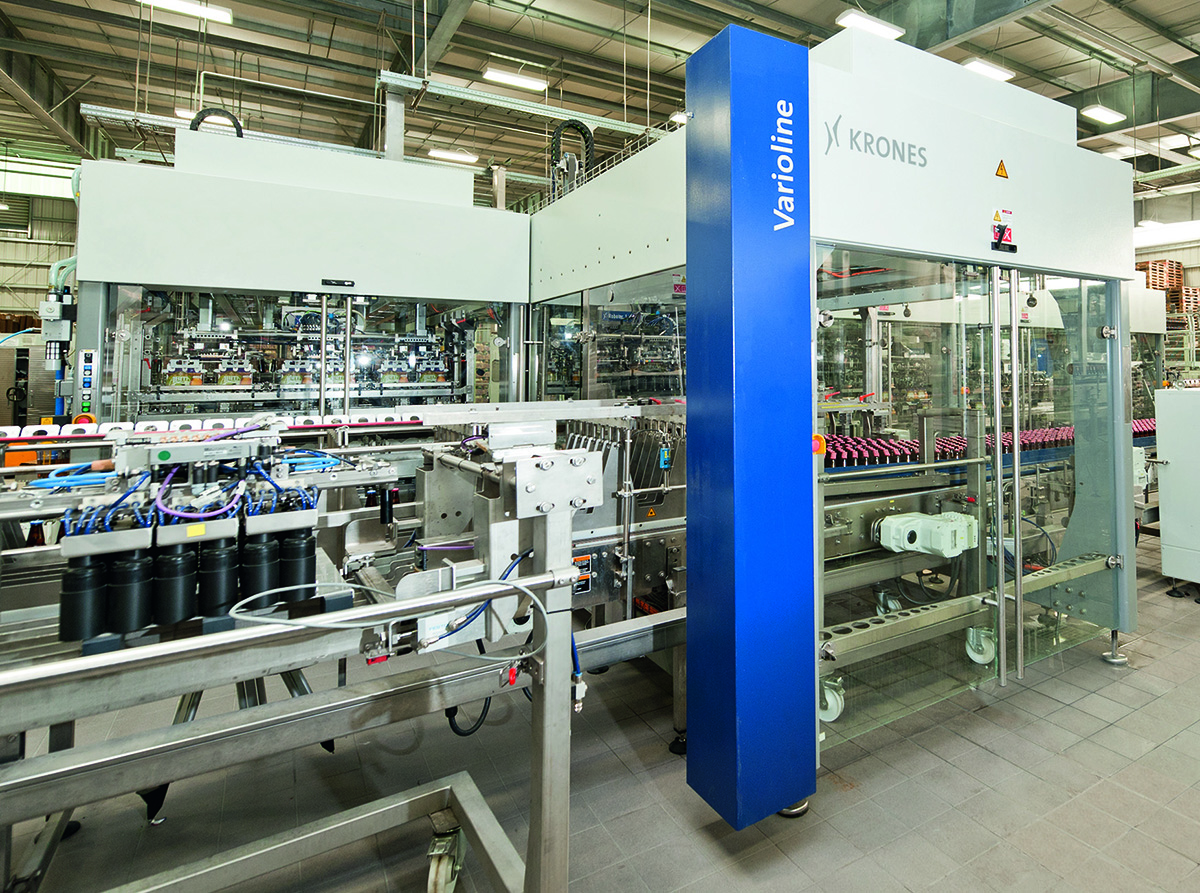
Abita’s Varioline consists of five modules. If, for example, four six-packs and one full-depth tray are being packed, the first module erects the wrap-around cartons, while the second packs six bottles at a time in them (Photo: Krones)
Brewing beer with Steinecker’s technology
For the brewing process itself, Abita relies on Steinecker’s technology. The brewery was in 2000 the first outside Europe to use the revolutionary new Merlin wort boiling system, which reduces the boiling time from 90 to 35 minutes, and thus cuts the energy consumption involved by 70 per cent. A vapour condenser also recovers process steam. The four-vessel brewhouse, given a brew size of 120 hectolitres and a brew duration of 4.5 hours, provides an annual capacity of 150,000 hectolitres. By downsizing the brewing time from 3.5 to its present-day three hours thanks to installation by an additional heat exchanger and a buffer tank, plus faster spent-grains removal, Abita can even produce eight brews a day. For fine-tuning the aroma and flavour of its beers, Abita attaches great importance to a triple hop strike with bittering, flavouring and aroma hops. Some beers are aslo dry-hopped in the storage tank, such Jockamo I.P.A. and Restoration Ale. Before filling, the beers are cold-filtered, first being separated in a centrifuge, and then filtered in a plate filter. The brewery does without a stabilising stage.
Filling quality significantly improved
With demand continuing to rise, it was more than high time to think about installing a new bottling line. The existing Italian line, dating from 1999 and rated at 9,000 bottles per hour, had long since come up against the limits of its capacity. “The more we asked of it, the more its efficiency declined,” explains David Blossman. “We wanted the new line to provide more capacity, offer higher efficiency, deliver a better filling quality, and be a lot more flexible. The fill level accuracy was no longer acceptable, the pasteurisation was not reliable enough, labelling and end-of-the-line packaging left a lot to be desired, the efficiency was dropping towards 80 per cent.” With the new Krones line, which started operation in November 2011, David Blossman had translated his ideas into productive reality: the rating, at 24,000 bottles per hour, is more than twice as high, the efficiency envisaged is over 90 per cent, the oxygen content in the glass bottles is a minimal 0.1 milligrams or less per litre, and the fill levels are correct – thanks to accurate filling and immediate monitoring with a Checkmat FM-X, which additionally inspects the closure position. Abita is still using the traditional 355-millilitre “Heritage” bottles with a short neck, where the head space is significantly smaller than in the modern long-neck bottles, and thus minimises the amount of air in the necks. “The LinaFlex tunnel pasteuriser is an extremely reliable machine,” emphasises David Blossman. “Because it’s divided into separate zones, each with its own separate cooling and warming circuit, we don’t get any under- or overpasteurisation. The desired 15 PUs (pasteurisation units) are precisely complied with. An intelligent machine.”
High flexibility thanks to parallel positioning of the bottle and can fillers
Abita has achieved a high level of flexibility in two ways: firstly by having the bottle and can fillers installed in parallel and secondly by means of the Varioline packaging system. For filling its bottles, the brewery installed a Modulfill HRS (VPKV) filler, which is block-synchronised with a Variojet rinser. “It was the Modulfill’s significantly hygiene-friendlier concept without a front table that I found persuasive. What’s more, I much prefer servomotors to gearwheels, which enables change-overs to be speeded up, and in turn benefits our flexibility. This also applies to the Solomodul labeller – fewer mechanical parts, more electronics mean more flexibility.” As an alternative to filling bottles, Abita can for the first time fill its beer in 330-millilitre cans, likewise at a rating of 24,000 cans per hour. “We didn’t want to be the first craft brewery to fill its beer in cans. For a long time, there was a certain amount of resentment among consumers, who felt that canned beer was inferior. That has now changed.”
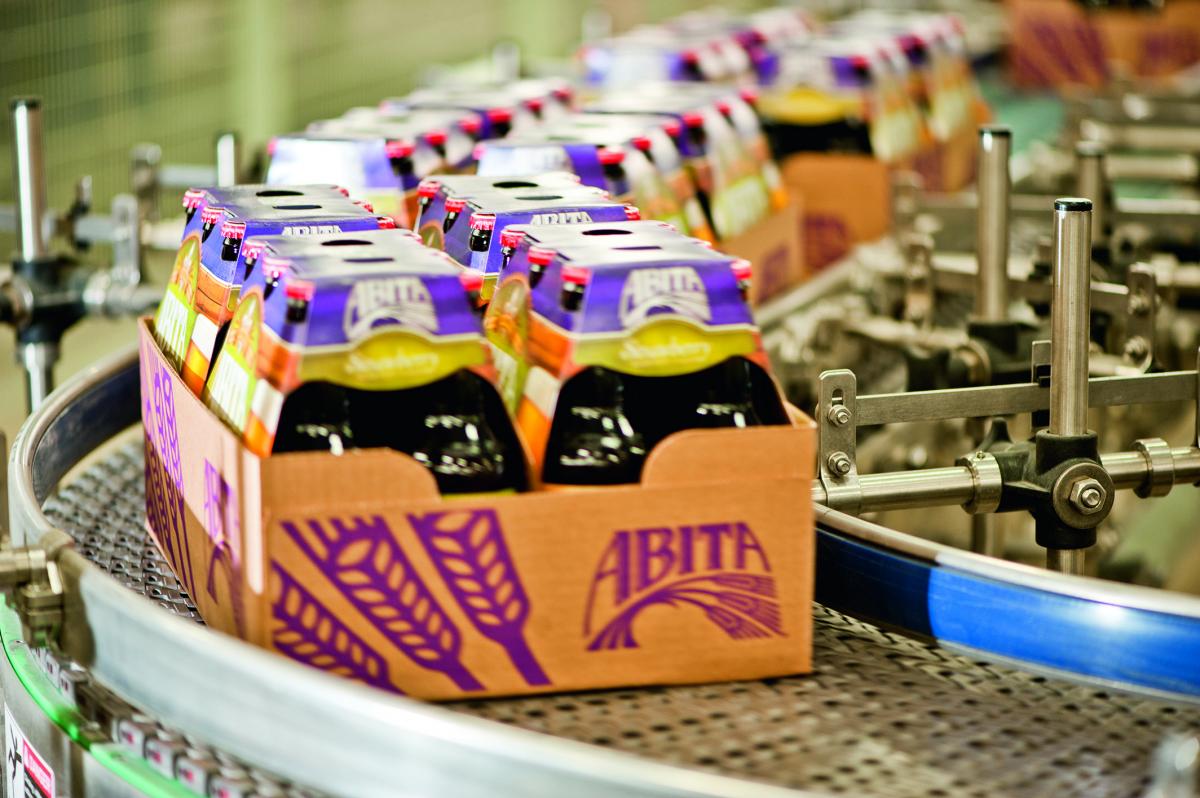
On the Varioline, Abita packs the 355-millilitre bottles as open 24-bottle trays, four- and six-packs in full-depth trays, and two times twelve-packs in half-depth trays (Photo: Krones)
Craft beer in cans?
Can the image of craft-brewed beer be reconciled with having it filled in cans? Abita thought long and hard before taking this decision. How would canned beer be received by consumers loyal to glass, what would Abita from cans taste like? Two points then ultimately tipped the balance: firstly, at many public events glass bottles are not permitted, due to the injury risk, particularly at the Mardi Gras. Every spring, this world-famous carnival in New Orleans attracts hundreds of thousands of locals and visitors from all over the world, who of course while they’re celebrating and during the parades also want to drink a local beer. Beer in cans, however, is also practical when you’re going fishing, playing golf, on the beach or at a party. Consumption opportunities that Abita didn’t want to miss out on. “Louisiana is a paradise for sports fans, offering an abundance of leisure activities: just think of the 3,000 miles of coastline, more than 400 festivals every year, almost 200 golf courses and 22 national parks,” comments David Blossman. “All good reasons for putting our Abita beer in cans.”
A second important consideration was the question of what Abita beer out of cans was going to taste like. “For years, consumers associated craft beer exclusively with glass bottles. Beer from cans was always suspected of tasting metallic. But acceptance levels for aluminium cans, and the concomitant technology, have really changed in the meantime. We are confident that present-day cans offer a quality solution for protecting the taste of our beers,” believes David Blossman. Abita’s cans are coated with a water-based layer inside, which prevents any direct contact between the product and the aluminium surface, thus preserving the authentic taste of the beer. In addition, the can protects the beer from UV rays which otherwise would cause it to age faster.
The adverse effects of oxygen on freshness, finally, are minimised by Krones’ modern filling technology. In parallel to the new bottling line, Abita installed a volumetric can filler, a Volumetic VOC with 26 filling valves and a rating of 24,000 cans per hour. The cans are packed in six-packs and twelve-packs, and in 24-can cartons at a speed of 1,000 cartons per hour.
One of the first Varioline packaging systems
The biggest flexibility-enhancer, however, was without a doubt the Varioline, one of the first to be installed by Krones worldwide in 2011. “This machine offers us amazing flexibility coupled with a minimised footprint. It’s more or less four machines in one. We need at least 40 per cent less space, and that’s important, because when you’re calculating a machine’s total costs you also have to factor in the floor space involved,” explains David Blossman. By reason of its multifaceted product portfolio, Abita uses the Varioline for an abundance of different packages:
- four six-packs of bottles in full-depth trays
- two twelve-packs of bottles in half-depth trays
- two assortment twelve-packs of bottles in half-depth trays
- four six-packs of cans in full-depth trays
- two twelve-packs of cans in half-depth trays
- four six-pack-ring units in wrap-around cartons
- 24 x 355-millilitre bottles in wrap-around cartons
- twelve 750-millilitre bottles in wrap-around cartons.
Abita was able to offer the market only six-packs of bottles as neck-through packs and twelve-packs in corrugated boxes, plus mixtures featuring two bottles each of the six different brands. These “Variety Packs”, too, are now being handled by the Varioline.
Abita’s Varioline consists of five modules. If, for example, four six-packs and one full-depth tray are being packed, the first module erects the wrap-around cartons, the second packs six bottles at a time in them, the third erects the full-depth tray, and in parallel the six-packs are sealed. The fourth module packs the four six-packs in the full-depth trays, and the fifth module discharges the tray onto a conveyor.
The entire line is controlled by a Krones LDS (line documentation system). “That’s a very user-friendly option for system management,” is David Blossman’s verdict. “It’s self-explanatory, and you can access it from anywhere, even from your home, or if necessary Krones’ technicians in Germany can do it.” For its maintenance work, Abita uses a KAM (Krones Asset Management) system. The new line has also enabled Abita to reduce its labour costs. Whereas the old line was run in two extended shifts with six operators each, the new line manages with one extended shift, manned by just four staff.
Auspicious prospects
David Blossman is extremely confident about the future of his own brewery and the craft-brewing sector as a whole. “Craft beer is gaining steadily in popularity, because Americans are discovering the authentic taste of full-bodied beer. Once consumers have had their eyes opened, or to be more precise their taste buds, they’ll stay with it. Thanks to the craft-brewing movement, there’s a veritable taste revolution ongoing in the world of beer, with a lot more choice available. Even in economically difficult times, sales are still growing. Our consumers are relatively well-educated people who like good food, are open to experimentation, and also appreciate a really good beer. Quality by dispensing with additives, and a wide diversity of choice – these are the salient features of the craft-brewing industry."
Air Max Shox 2018