
 Access
 Login/Register
 Supplier Login












VEOLIA Water Technologies conducted its Think Tank Asia 2 seminar at ESSEC Business School’s Asia-Pacific campus in Singapore last on 12 July 2016.
The full-day executive workshop gathered 20 leaders and influencers from key industries across Asia to explore future business models and to spread environmental awareness in the region.
The seminar aimed to open up discussions on sustainable innovation as solutions to today’s needs based on the growing demand for raw materials brought about by factors including growing global population, rising living standards, and climate change.
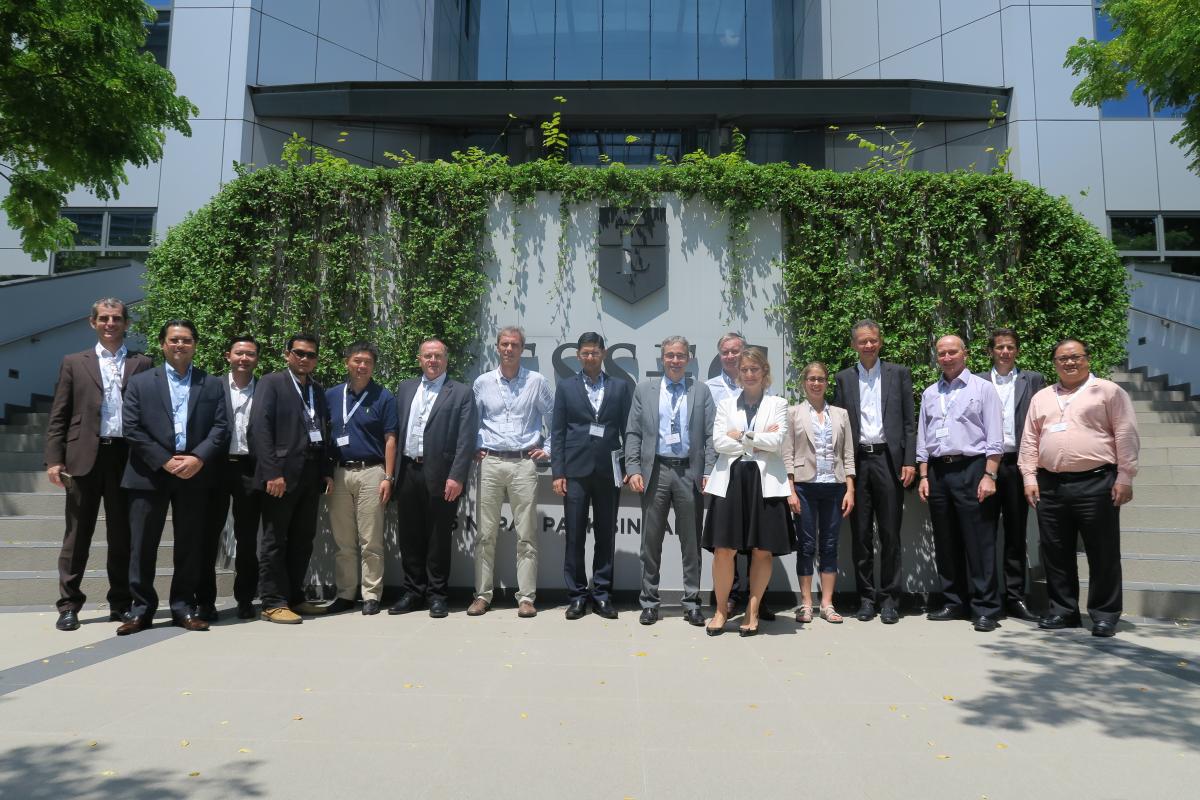
Participants at the second edition of Think Tank Asia, co-organized by Veolia and ESSEC Business School
Companies are enjoined to adapt their business strategies to become less resource-intensive in the face of increasing resource scarcity. Innovative solutions and green business models have to emerge to achieve economic sustainability, while reducing the industry’s overall environmental footprint. This becomes imperative as the natural environment is being stretched thin due to the continued extraction of resources.
Ivy Latour, Marketing & Communication Director (APAC), Veolia Water Technologies, shared, “After the successful launch of our first Think Tank Asia last December, Veolia initiated a follow-up session as we believe that it’s vital to encourage more collaboration, exchange, and partnerships between municipalities and industries, so as to co-construct sustainable growth. This time, we invited more like-minded industry professionals who, like Veolia, strive to drive their businesses forward through innovation in a resource-scarce world, and it proved to be a great knowledge-exchange and networking session for everyone involved.”
Designed by the Institute of Sustainable Development and Smart Cities, ESSEC Business School, the workshop engaged participants in a critical discussion of the geopolitical issues and factors around the sourcing of natural resources, and in an exploration and analysis of key business concepts that effectively drive sustainable innovation.
The first session focused on the politics and markets of resources, and participants’ discussions were largely centered on how governments and the open markets play considerable roles in determining corporations’ access to scarce resources. The attendees were challenged to think about issues faced by corporations when accessing resources, whether directly (e.g. exploration and production) or indirectly (e.g. market procurement).
In the second session, on sustainable sourcing of resources, Ynse de Boer (Managing Director for Strategy & Sustainability at Accenture Strategy), introduced the idea of circular economy business models in supply and value chains. Leading organizations have adopted various new business models – such as the Circular Supply Chain, Recover & Recycle, Sharing Platform, Product Life Extension, and Product as a Service – to gain a competitive edge even as they become more sustainable. Business leaders in attendance were encouraged to consider the barriers that prevent companies from transitioning from a linear to a circular economic model, and were inspired to explore beyond the perceived limitations of their current business models.
According to Sylvain Remy, Director of the Institute of Sustainable Development and Smart Cities at ESSEC Business School, achieving better sustainability has become vital for Asia. He said, “The knowledge partnership between Veolia and ESSEC aims to develop a space, a kind of think tank, for the business community – not just to share state-of-the-art knowledge and practices, but also to inspire bold and viable projects. The initiative has attracted very positive responses from global MNCs that are in a position to make significant differences in terms of resource consumption.”
Ms Latour concluded, “Protecting the environment is a priority for Veolia. By facilitating open discussions on how businesses can reduce their ecological footprint, we are one step closer to conserving precious raw materials for future generations. We need to recognize that there are limitations to what we can extract from the environment, and to uncover creative ways to reuse what has already been extracted. We are now operating in a world with limited resources, but if we adapt quickly, we can delay a future where we are left with zero resources.”
Shop Women's Sneakers by Brand